
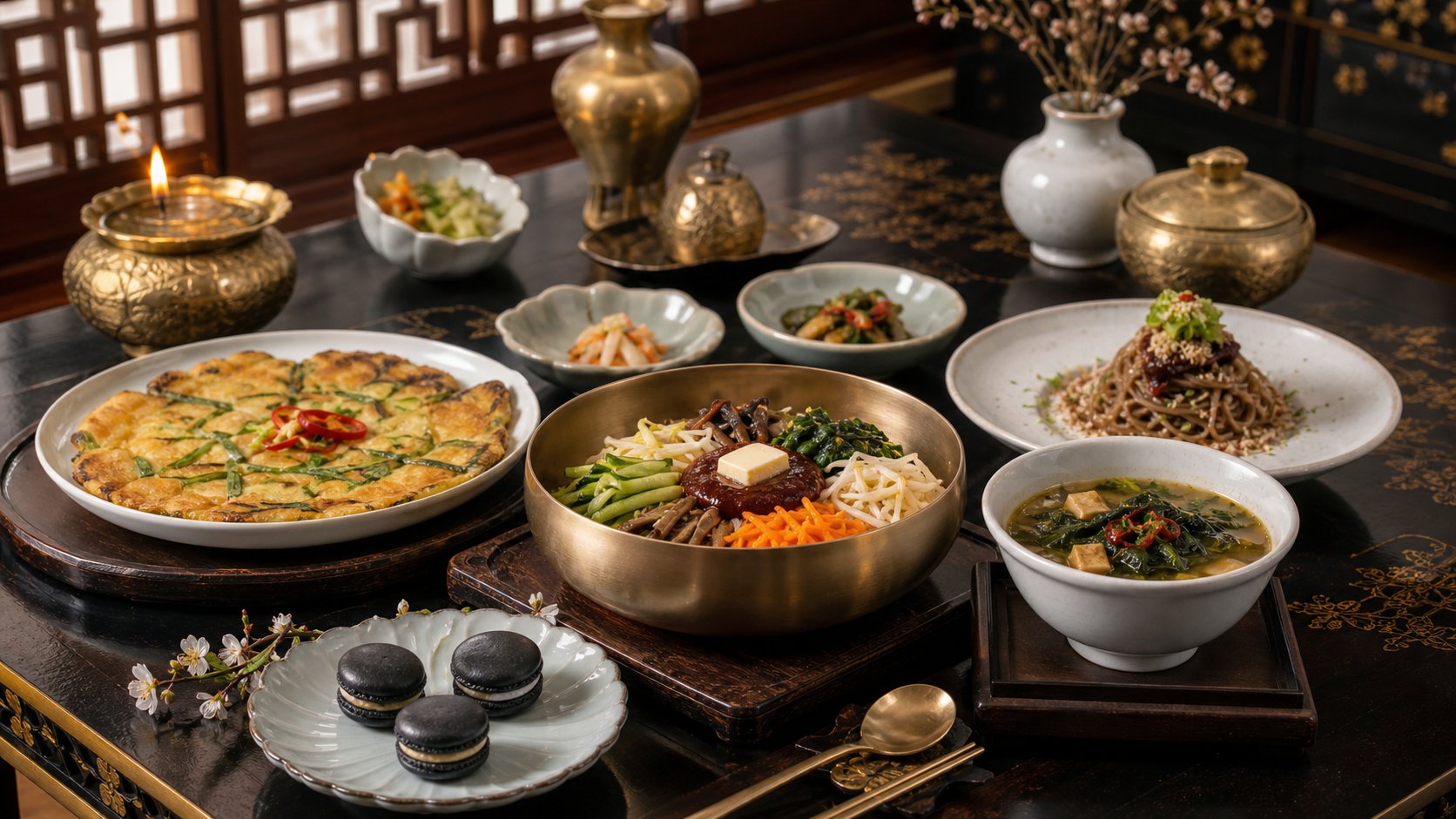
The Korean food in Bon Appétit Your Majesty is not one single style of royal cuisine. It moves between familiar home food, Joseon-inspired palace dishes and inventions that combine Korean ingredients with modern French technique.
That distinction matters. Gochujang butter bibimbap and doenjang pasta look believable because their flavors make sense, but they are intentionally time-bending fusion—not museum reconstructions of meals served exactly that way in the 1500s.
Quick answer: The easiest dishes to understand and recreate are gochujang butter bibimbap, spinach doenjang soup and Dongnae pajeon. Doenjang pasta, snowflake schnitzel and rice-wine beef bourguignon are modern fusion. Black sesame macarons, pressure-cooked ogyetang and soy-meat gujeolpan are more ambitious showpieces.
Spoiler note: This guide identifies dishes through Episode 11 and includes light food-related story context, but it does not explain the final plot resolution.
Editorial note: K-Food Explained is not affiliated with Netflix, tvN, Studio Dragon or the series. This is an independent food guide based on official series information and interviews with the culinary team, linked below.
Why the Food Looks So Convincing
Bon Appétit, Your Majesty follows French-trained chef Yeon Ji-young after she travels back to the Joseon era and must cook for King Yi Heon. Netflix describes the series as a time-slip story in which her modern dishes captivate the king while palace challenges place her in constant danger.
The food was not improvised only for the camera. The production worked with French chefs, Korean and fusion chefs, a Chinese-cuisine adviser, food researchers and a specialist in royal court cuisine and ancient cookbooks. Director Chang Tae-you told Korea.net that the team used on-site consultations and cooking demonstrations to support the Joseon setting.
Menu director Shin Jong-cheol told Forbes that individual dishes went through repeated cooking experiments. The team also checked which ingredients and methods could plausibly fit the period before adapting modern food to the story.
That research does not make the drama a documentary. It makes the fantasy more thoughtful. Chili peppers and gochujang were not available in Korea at the moment Ji-young enters the 1500s, for example; the first episode solves that problem by giving her a tube of gochujang from her own time.
Read the Korea.net interview with director Chang Tae-you →
12 Bon Appétit, Your Majesty Dishes at a Glance
| Dish | Episode | Best description |
|---|---|---|
| Gochujang butter bibimbap | 1 | Korean base with a modern French twist |
| Joseon-style sous-vide beef | 2 | Modern technique adapted with old materials |
| Korean-French haute cuisine | 3 | Fusion tasting menu |
| Clam and spinach doenjang soup | 4 | Closest to Korean home cooking |
| Doenjang pasta | 4 | Historic noodle inspiration, modern fusion sauce |
| Snowflake schnitzel | 5 | European cutlet adapted to Joseon ingredients |
| Black sesame macarons | 6 | French pastry with Korean flavor |
| Dongnae pajeon | 7 | Regional Korean pancake |
| Rice-wine beef bourguignon | 8 | French stew with a Korean alcohol substitution |
| Pressure-cooked ogyetang | 9 | Royal-style black chicken and ginseng soup |
| Joseon “Restaurer” | 10 | Fictional restorative tteok-and-sujebi dish |
| Soy-meat gujeolpan and eggplant pie | 11 | Royal presentation with plant-based fusion |
1. Gochujang Butter Bibimbap
The first major dish establishes the show’s entire idea. Bibimbap is fundamentally Korean: rice mixed with vegetables and seasonings, often with gochujang and egg. Ji-young replaces the usual nutty note of sesame oil with browned butter, which softens the chile heat and gives the bowl a richer aroma.
The dish should taste spicy, savory, lightly sweet and buttery, with different textures from the vegetables. It is also one of the easiest ideas in the series to try at home. Use cooked rice, blanched or sautéed vegetables, a soft egg, a small amount of gochujang and browned butter. Do not drown the bowl in either sauce.
Historical reality: The bibimbap-like grain-and-vegetable base is plausible, but this exact gochujang-and-butter combination is the drama’s time-slip invention. Ji-young carries both modern ingredients into the past.
2. Joseon-Style Sous-Vide Beef
In Episode 2, Ji-young must tenderize a difficult cut of beef without a modern vacuum sealer or temperature-controlled bath. The production’s royal-cuisine researcher explained that she adapts an older slow-cooking idea: the meat is protected with oil-treated Korean paper and cooked gently with water.
This is not proof that Joseon cooks practiced modern sous vide. It is a fictional bridge between two principles that cooks across eras understand—protect moisture and use gentle heat to soften meat.
What it would taste like: tender beef with restrained seasoning and concentrated meat flavor rather than the browned crust of a hard sear. At home, use a properly tested sous-vide recipe and food-safe equipment; do not copy paper-wrapping temperatures from a television scene.
3. Korean-French Haute Cuisine
Ji-young’s palace haute-cuisine menu presents French course structure with Korean game, seaweed and charcoal cooking. The most discussed elements include tartare served with crisp kelp and thinly sliced deer tongue cooked over charcoal.
Yukhoe, Korea’s seasoned raw beef dish, helps make the tartare concept feel less foreign in a Korean setting. Yet the precise plating and multi-course presentation express Ji-young’s modern French training rather than a standard Joseon meal.
Home warning: Raw beef and game require expert sourcing, strict refrigeration and careful handling. This is a dish to understand or order from a trusted professional—not the first scene I would recommend copying in a home kitchen.
4. Clam and Spinach Doenjang Soup
This humble set meal may be the most emotionally Korean food in the series. Doenjang gives the broth its salty, earthy fermentation; small clams add briny sweetness; spinach softens into the soup and balances the paste.
Unlike the dramatic steak and pastry sequences, this bowl is recognizable as home cooking. It shows how a modest soup can carry memory more powerfully than an elaborate banquet.
If the drama sent you looking for fermented soybean paste but you cannot find it locally, start with my doenjang substitute guide. Miso can help in an emergency, but Korean doenjang usually tastes stronger, rougher and more deeply fermented.
5. Doenjang Pasta
Doenjang pasta sounds like a social-media invention, but the production put serious thought into it. According to the culinary team, the noodles were inspired by nanmyeon from the Joseon-era cookbook Eumsikdimibang and made with buckwheat and egg. The sauce combined several kinds of doenjang.
The likely flavor is earthy, salty and nutty, with the buckwheat echoing the grain character of the paste. Clams and spinach bring the same savory-sweet partnership seen in the soup while the plating reads as pasta.
What is traditional? The fermented paste and historic noodle reference. What is fusion? Treating them as a modern restaurant pasta with French-influenced presentation.
6. Snowflake Schnitzel
Schnitzel normally depends on breadcrumbs and is often served with potatoes. The show’s version works around both problems. The culinary team used refined wheat-flour batter and a “snowflake” frying technique for the crisp coating, then replaced potato fries with fried burdock.
That substitution is more than decoration. Burdock has an earthy flavor and fibrous bite that makes the plate feel connected to Korean roots even when the central idea is European.
What it tastes like: crunchy coating, tender meat and a darker, earthier side dish than familiar French fries. It is a clever period adaptation, not a historical Korean schnitzel recipe.
7. Black Sesame Macarons
The macarons are deliberately anachronistic French pastry dressed in Korean flavor. Black sesame gives the filling an intense roasted nuttiness and dramatic dark color. Other Korean-inspired flavors associated with the show’s pastry presentation include ingredients such as mugwort and jujube.
The production team even considered how Ji-young could obtain butter, using suyu made by heating and solidifying milk. That does not turn macarons into Joseon royal cuisine; it shows how the character translates modern pastry knowledge with limited tools.
Difficulty: high. Macarons are sensitive to measurements, meringue and oven behavior. For most viewers, buying a black-sesame macaron from a skilled bakery is more realistic than treating a drama montage as a full recipe.
8. Dongnae Pajeon
Dongnae pajeon is a regional scallion pancake associated with the Dongnae area of Busan. It puts long green onions at the center rather than chopping them into an anonymous batter. Seafood, egg and other additions vary by version.
In the drama, the pancake functions as food memory. Its appeal is easy to understand: crisp, browned edges; a softer egg-rich center; sweet scallions; and savory ingredients held together in each piece.
This is one of the three show dishes I would recommend trying first. It is more forgiving than macarons, easier to source than ogolgye, and makes sense as a shared snack on a rainy evening.
9. Rice-Wine Beef Bourguignon
Beef bourguignon is French, but Ji-young adapts the slow-cooked stew with Korean rice and wild-grape wine. The idea preserves the dish’s central logic—beef braised patiently in wine—while replacing Burgundy wine with something the story can connect to Korea.
The result should be rich, savory and faintly fruity, with tender meat and a glossy sauce. It is unmistakably fusion rather than Korean royal food.
If you plan to cook with Korean alcohol, remember that products differ in sweetness, acidity and alcohol level. My Korean cooking wine guide explains why bottles labeled rice wine are not automatically interchangeable. Cooking also does not guarantee that every trace of alcohol disappears.
10. Pressure-Cooked Ogyetang
Ogyetang here centers on ogolgye, a black-skinned silkie chicken, with ginseng and other restorative-soup ingredients. The competition version uses a specially constructed pressure cooker, then adds refined elements such as chicken dumplings, stuffed morel mushrooms and crisp nurungji (scorched rice).
The reference point for many international viewers is samgyetang: whole young chicken cooked with glutinous rice, garlic, jujube and ginseng. The show turns that comforting soup family into an elaborate competition plate.
What it tastes like: deep chicken broth with earthy, herbal notes and contrasting crisp rice. Silkie chicken is not required to understand the flavor; a well-made samgyetang is the more accessible real-world introduction.
11. Joseon “Restaurer”
Episode listings often call this course “Joseon Restaurant,” but the food idea is closer to the French verb restaurer—to restore or refresh. Ji-young prepares a soft, energy-dense dish for someone too weak to handle ordinary food.
The bowl combines rice cakes and sujebi, hand-torn wheat dough pieces, in a nourishing broth. The series gives that broth medicinal and luxury ingredients appropriate to palace fantasy, then uses French sauce logic to refine the texture.
This is not a widely recognized historical dish you can order by saying “Joseon Restaurer” at a Korean restaurant. It is a drama-created fusion course built from recognizable Korean components.
12. Soy-Meat Gujeolpan and Eggplant Pie
Gujeolpan refers to an elegant nine-section presentation: colorful fillings are arranged around thin pancakes, and diners wrap combinations for themselves. Traditional versions may include seasoned meat, egg, mushrooms and vegetables.
The drama adapts the centerpiece for a diner avoiding meat by using soy-based meat and serving an eggplant pie alongside it. The gujeolpan form is rooted in Korean banquet presentation; the plant-based filling and pie make the plate Ji-young’s fusion interpretation.
What it tastes like: no single dominant flavor. The pleasure comes from alternating soft pancakes, crisp vegetables, savory mushrooms, seasoned soy and rich eggplant. It is designed to be assembled bite by bite.
Which Three Should You Try First?
- Gochujang butter bibimbap: the clearest expression of the show’s Korean-French idea and easy to adapt with supermarket vegetables.
- Clam and spinach doenjang soup: the best choice if you want to taste something closer to everyday Korean home cooking.
- Dongnae pajeon: a shareable, approachable dish with ingredients that are easier to find than royal chicken or specialty game.
For ingredients outside Korea, use my guide to buying Korean ingredients online in the USA. If one component is missing, check the broader Korean ingredient substitution guide before changing several ingredients at once.
Dietary and Safety Notes
- Soy and wheat: doenjang, gochujang, soy sauce, noodles, pancakes and sujebi may contain them.
- Shellfish: clam soup, pajeon and doenjang pasta may include clams or other seafood.
- Egg, milk and sesame: these appear repeatedly across the pasta, pancakes, macarons and sauces.
- Alcohol: the bourguignon-style dish uses wine; retention varies with method and cooking time.
- Raw meat: do not recreate tartare without an appropriate supplier and safe handling knowledge.
Formulas vary by producer, so check the actual package rather than relying only on a dish name. My Korean food label guide explains where allergen and ingredient information usually appears.
Frequently Asked Questions
Is every dish in Bon Appétit, Your Majesty authentic Joseon royal cuisine?
No. The production researched Joseon ingredients, tools and court food, but the central concept is fusion. Several courses deliberately combine modern French methods with Korean ingredients.
Did gochujang exist when Ji-young arrived in the 1500s?
Not in the modern form used in the first dish. The drama addresses this by having Ji-young carry gochujang from her own time. The culinary consultant noted that chili peppers and red seasonings were not yet available in Korea at that point in the story.
What is the easiest Bon Appétit, Your Majesty food to make?
Gochujang butter bibimbap is the simplest concept because you can use common vegetables, rice and an egg. Pajeon is also approachable. Both are more forgiving than macarons or raw-meat courses.
What is the most traditional-tasting dish in the show?
Clam and spinach doenjang soup is the strongest answer among these 12. Its fermented soybean broth, greens and clams feel much closer to Korean home cooking than the French-inspired competition plates.
Where can I watch the series?
Netflix lists Bon Appétit, Your Majesty as a 2025 TV-14 Korean fantasy romantic drama. Availability can vary by country, so check your local Netflix catalog rather than assuming every region is identical.
My recommendation: Do not try to reproduce the entire royal table first. Make one bowl of gochujang butter bibimbap and one simple doenjang soup on different days. Together, they show the drama’s two food personalities: bold modern fusion and quiet Korean comfort.
Sources: Netflix Tudum; Forbes interview with the culinary consultants; The Korea Times on the production’s K-food research; the official tvN episode guide; and Prestige’s dish-by-dish series guide.
🛒 Stock Your Korean Pantry
- Doenjang (fermented soybean paste) — deep, savory umami for stews → View on Amazon
- Gochujang (Korean chili paste) — the backbone of Korean cooking → View on Amazon
- Ssamjang (dipping paste) — the BBQ wrap essential → View on Amazon
This post contains affiliate links. As an Amazon Associate, I earn from qualifying purchases.
