
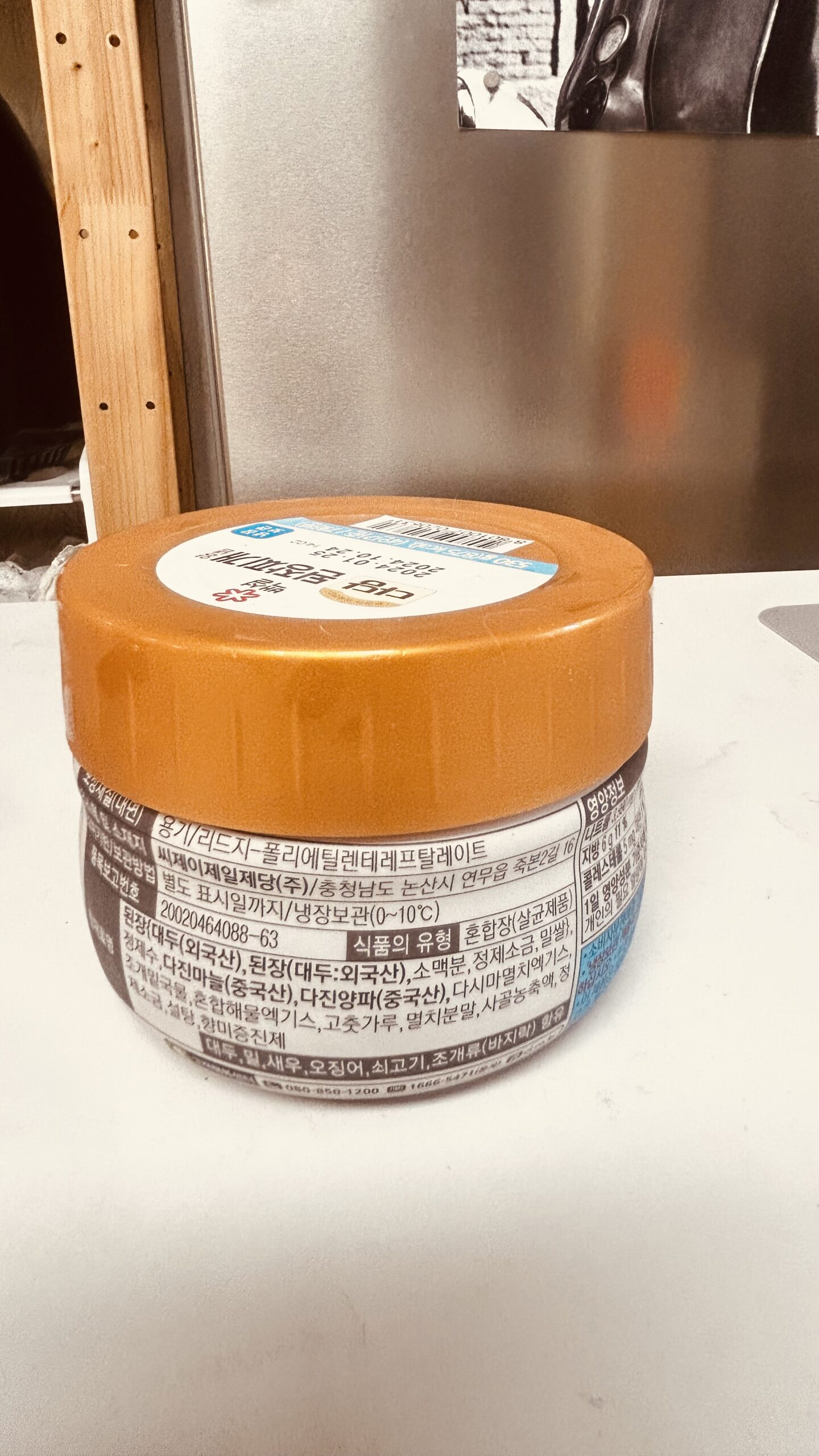
How to Read Korean Food Labels: Ingredients, Allergens, Dates & Origin
Affiliate disclosure: As an Amazon Associate I earn from qualifying purchases. This post may contain affiliate links; if you buy through them, I may earn a small commission at no extra cost to you.
Quick answer: When you buy Korean food in the US, Canada, UK, or EU, read the local importer label first. Then check the Korean package for seven clues: 제품명 (product name), 식품유형 (food type), 원재료명 (ingredients), 함유 (contains), 원산지 (origin), 소비기한 (use-by date), and 보관방법 (storage). The front of the package sells the product; these words tell you what you are actually buying.
Important allergy note: This is a shopping guide, not medical advice. Recipes and labels can change. If you have a food allergy or celiac disease, use the current label made for your country and contact the manufacturer or importer when anything is unclear.
I grew up in Seoul, where I could read a food package without thinking about it. Moving first to the US and later spending several years in London changed the way I shop. A tub could look completely familiar from the front, but the small importer sticker on the back might reveal wheat, fish sauce, a different heat level, or ingredients sourced outside Korea.
Now, when I shop for Korean ingredients in Washington, I turn the package around before I look at the brand. This is the order I use.
The 30-Second Korean Label Check
- Find the local-language importer label. In the US, start with English; in Canada, look for English and French; in the UK, English; and in the EU, the language required where the food is sold.
- Confirm the exact food. Find 제품명 (product name) and 식품유형 (food type). This prevents buying ssamjang instead of doenjang, or vinegared cho-gochujang instead of plain gochujang.
- Read allergens before anything else. Look for 함유 (contains) and any bold or highlighted allergens on the local label.
- Scan the first few ingredients. Korean ingredients are generally listed from most to least by weight; ingredients below 2% may appear without strict weight order.
- Check origin correctly. “Made in Korea” does not mean every ingredient was grown in Korea.
- Read the date label and storage instruction together. A date is only meaningful if the food has been stored as directed.
- For online orders, check the actual seller, package size, back-label photos, and return policy. Do not rely only on a marketplace title.
First Rule: Read the Importer Sticker Before Translating the Korean
If a Korean food is legally sold in your country, it should carry the required local information. That local label is not decoration—it is the practical starting point for ingredients, allergens, nutrition, storage, and the responsible importer.
- United States: Imported foods must comply with FDA labeling rules and carry truthful labeling in English. Sesame has been one of the nine major US allergens since January 1, 2023.
- Canada: Most consumer prepackaged food must show mandatory information in both English and French. Canadian authorities specifically advise online shoppers to choose products made for the Canadian market because allergen lists differ by country.
- United Kingdom: Prepacked food sold in the UK must provide required information in English and emphasize any of the 14 regulated allergens in the ingredient list.
- European Union: Mandatory food information must appear in a language easily understood by consumers in the country where it is sold. Allergens must be emphasized.
Why I still check the Korean label
The local label is the safety starting point, but the original package can answer useful buying questions:
- Is this actually 고추장 (gochujang), or a ready-made 소스 (sauce)?
- Is the heat level 보통 매운맛 (medium hot) or 매우 매운맛 (extremely hot)?
- Is the rice Korean-grown but the chili imported?
- Is the stamped date a manufacture date or a use-by date?
If the local sticker and the original package appear to conflict, do not guess—contact the importer or choose another product.
Korean Food Label Words Worth Saving on Your Phone
| Korean on the package | Meaning | Why it matters |
|---|---|---|
| 제품명 | Product name | The official product name, not just the large marketing words on the front |
| 식품유형 | Food type/category | Helps distinguish a traditional paste from a seasoned sauce or mixed paste |
| 원재료명 | Ingredients | Shows what the product is made from |
| 원재료명 및 함량 | Ingredients and amounts | Includes percentages for highlighted or characterizing ingredients |
| 함량 | Amount/content | Often followed by a percentage |
| 함유 | Contains | Common in allergen statements, such as 밀, 대두 함유 |
| 혼입 가능 | May be present / possible cross-contact | Important for allergies |
| 원산지 | Country/place of origin | May refer to a specific ingredient, not the finished product |
| 국내산 / 국산 | Korean-grown or Korean-origin | Refers to the ingredient it follows |
| 외국산 / 수입산 | Foreign/imported origin | The ingredient was sourced outside Korea |
| 제조국: 대한민국 | Made in the Republic of Korea | Describes where the product was made, not necessarily where all ingredients came from |
| 내용량 / 총 내용량 | Net weight / total net weight | Use it to compare price per 100 g, not just tub price |
| 제조일자 | Manufacture date | Not the expiry date |
| 소비기한 | Use-by date | Safety-based date when stored as directed |
| 품질유지기한 | Best-before / quality-retention date | Mainly about expected quality |
| 유통기한 | Old sell-by/distribution deadline | Older Korean wording; not the same as a modern consumer use-by date |
| 보관방법 | Storage instructions | Read this with the date |
| 개봉 후 냉장보관 | Refrigerate after opening | Common on pastes and sauces |
| 냉장보관 / 냉동보관 | Keep refrigerated / keep frozen | Do not order without suitable cold-chain delivery |
| 직사광선을 피하고 서늘한 곳에 보관 | Store in a cool place away from direct sunlight | Common before-opening instruction for shelf-stable pantry foods |
| 영양정보 | Nutrition information | Check serving basis before comparing products |
| 1회 제공량당 | Per serving | The numbers are for one stated serving |
| 총 내용량당 | Per total package | The numbers cover the full container |
How to Read the Ingredient List
Under Korean labeling rules, ingredients are generally listed in descending order by weight. The first ingredient therefore tells you more than a front-label illustration does. Ingredients present below 2% may be listed without following strict weight order.
This does not mean the shortest list is automatically the best. It means you can compare two products according to what matters to you: rice content, chili content, sweetness, allergens, or added seasonings.
Common Korean ingredient words
| Korean | English | Shopping note |
|---|---|---|
| 정제수 | Purified water | Often listed simply as water on an export label |
| 쌀 | Rice | Naturally gluten-free, but the finished product may not be |
| 찹쌀 | Glutinous/sweet rice | Despite the English word “glutinous,” rice itself does not contain gluten |
| 밀 / 밀가루 / 밀글루텐 | Wheat / wheat flour / wheat gluten | Avoid if the current local label does not meet your dietary needs |
| 보리 / 엿기름 | Barley / barley malt | A gluten source |
| 대두 / 콩 | Soybean / soy | Common in gochujang, doenjang, soy sauce, and seasoning powders |
| 탈지대두분 | Defatted soybean powder | Still soy |
| 메주 / 메주가루 | Fermented soybean block / powder | A base for traditional Korean jang |
| 고춧가루 | Korean red pepper powder/flakes | Check percentage, origin, grind, and heat level |
| 물엿 | Starch syrup | Do not automatically translate it as corn syrup unless the label specifies corn |
| 올리고당 | Oligosaccharide syrup | A sweetener and texture ingredient |
| 설탕 / 당류가공품 | Sugar / processed sugar product | Check the nutrition panel for total sugars |
| 천일염 / 정제소금 | Solar sea salt / refined salt | “Sea salt” does not mean low sodium |
| 주정 | Food-grade alcohol/ethanol | Do not decide halal suitability from this word alone; look for a trusted halal certification |
| 효모추출물 | Yeast extract | Not the same ingredient as added MSG, although both can contribute savory flavor |
| L-글루탐산나트륨 | Monosodium L-glutamate (MSG) | May also be described with 향미증진제 (flavor enhancer) |
| 액젓 / 멸치액젓 | Fish sauce / anchovy fish sauce | Not vegan |
| 새우젓 | Salted fermented shrimp | Not vegan and a crustacean allergen |
| 젓갈 | Salted fermented seafood | The exact seafood may be shown in parentheses |
| 멸치 / 다시마 | Anchovy / kelp | Common in soup bases; only anchovy is animal-derived |
“No added” is not always the same as “free from”
The word 무첨가 means “not added.” Read what comes immediately before it. A “no added MSG” claim does not mean the food contains no naturally occurring glutamates or no yeast extract. Likewise, a front-label vegan-looking design is not a substitute for the ingredient and allergen panels.
Allergens: The Part You Should Never Translate Casually
Look for a separate, high-contrast allergen line near the ingredients. These are the two patterns to recognize:
- 밀, 대두 함유 = Contains wheat and soy
- 이 제품은 메밀을 사용한 제품과 같은 제조시설에서 제조하고 있습니다 = Made in a facility that also processes buckwheat
Korea requires separate labeling for a defined list of allergens, including eggs, milk, buckwheat, peanuts, soy, wheat, mackerel, crab, shrimp, pork, peach, tomato, sulfites at the regulated level, walnuts, chicken, beef, squid, shellfish including oyster/abalone/mussel, and pine nut.
But allergen rules are not identical across countries. This is the important part for overseas shoppers:
- Sesame is a major allergen in the US and is regulated in Canada, the UK, and the EU, but it is not one of Korea’s 19 mandatory allergen categories. On a Korean domestic label, you may need to find 참깨 (sesame), 참기름 (sesame oil), or 깨 in the ingredient list even when it is not highlighted in the Korean allergen box.
- The UK and EU also regulate allergens such as mustard, celery, and lupin that are not on Korea’s mandatory list.
- Canada includes mustard and sesame among its priority allergens and requires gluten sources to be declared according to Canadian rules.
My rule: if an allergy matters, use the local-market label first, read the full ingredients second, and contact the manufacturer or importer if the answer is not completely clear. A translation app is useful for shopping, but it is not an allergy guarantee.
Gluten-Free and Vegan: Korean Foods That Commonly Surprise Shoppers
Gochujang is not automatically gluten-free
Traditional descriptions often mention rice, chili, fermented soybeans, and salt, but many modern gochujang formulas contain wheat or wheat-derived ingredients.
For example:
- Sempio’s standard gochujang lists wheat extract and a soy seasoning containing wheat gluten. Its official allergen information lists wheat and soybeans.
- Sempio’s separately labeled gluten-free gochujang uses fermented rice paste and does not list wheat, but it still lists soybean essence and declares soy.
The lesson is not that one is “better.” It is that brand name alone is not enough—choose the exact variant and read the current label.
Doenjang and ssamjang often contain wheat
Doenjang is soybean paste, but commercial formulas can include wheat. Ssamjang is a seasoned mixed paste and can contain doenjang, gochujang, wheat, sesame, garlic, sweeteners, and other seasonings. Never assume either is gluten-free because soybeans are the main idea of the product.
Kimchi is not automatically vegan
Look for these words:
- 액젓 = fish sauce
- 멸치액젓 = anchovy fish sauce
- 새우젓 = salted shrimp
- 젓갈 = salted fermented seafood
For vegan kimchi, choose a product explicitly labeled vegan for your market and still recheck the ingredients each time you buy it. Recipes can change.
Dates: 소비기한 Is Not 제조일자
Korean dates are normally written year–month–day.
- 소비기한: 2027.05.08까지 = Use by May 8, 2027, when stored as directed
- 제조일자: 2026.05.08 = Manufactured on May 8, 2026
- 품질유지기한 = Best-before or quality-retention date
- 유통기한 = Older sell-by/distribution wording
Korea began replacing 유통기한 with 소비기한 in 2023. Some long-life foods—including certain sauces, pastes, kimchi, pickles, and retort products—may use either a best-before or use-by date under Korean rules.
Three date mistakes to avoid
- Do not treat 제조일자 as the expiry date. It is the manufacturing date.
- Do not guess an ambiguous 05/08 on an added sticker. The US often uses month/day, while Europe commonly uses day/month. Read the words around the date or ask the seller.
- Do not separate the date from storage. A chilled product that arrived warm or a tub with a broken seal is not made safe by a future printed date.
In the UK and EU, “use by” is about safety while “best before” is about quality. In the US, most packaged-food date labels are not federally required in the same way, except for infant formula, and “Best if Used By” generally describes quality. Follow the wording and rules on the label made for the market where you bought the food.
Country of Origin: “Made in Korea” Does Not Mean 100% Korean Ingredients
This is the label distinction that saves the most confusion:
- 제조국: 대한민국 = the finished product was manufactured in South Korea
- 쌀(국산) = the rice is Korean
- 고춧가루(중국산) = the chili powder is from China
- 대두(미국산) = the soybeans are from the United States
- 외국산 = foreign/imported origin
Read the noun immediately before the parentheses. Origin statements often apply ingredient by ingredient.
Also be careful with front-label words:
- 태양초 means sun-dried chili. It does not, by itself, mean the chili was grown in Korea.
- 순창 may identify a place, style, or branding. It does not automatically prove every ingredient came from Sunchang.
- 100% 국산 고춧가루 means the named chili powder is 100% Korean-origin. It does not automatically describe every other ingredient in the tub.
If Korean-grown ingredients matter to you, look for 국산 or 국내산 next to each important ingredient—not only a Korean flag or “Product of Korea” on the front.
Fermented, Aged, Traditional: What the Front-Label Words Really Tell You
| Korean claim | Meaning | What it does not prove by itself |
|---|---|---|
| 발효 | Fermented | That the finished food contains live probiotic cultures |
| 숙성 | Aged/matured | A specific aging period unless one is stated |
| 전통 | Traditional | That every ingredient is Korean or that the product was handmade |
| 태양초 | Sun-dried chili | Korean origin |
| 비건 | Vegan | Suitability for your allergy; still read the allergen panel |
| 글루텐프리 | Gluten-free | Absence of other allergens such as soy |
| HACCP | Produced under a food-safety management system | Organic, vegan, probiotic, or Korean-grown ingredients |
A product can be genuinely fermented and still not be a source of live microbes at the time you eat it. Processing, heat treatment, alcohol, storage, and time can all matter. If live cultures are your goal, look for a specific live-culture statement and follow the storage directions; do not rely on 발효 alone.
How to Avoid Buying the Wrong Korean Ingredient
| You want | Look for | Do not accidentally buy | Fast label check |
|---|---|---|---|
| Plain gochujang | 고추장; food type 고추장 | 초고추장 (sweet vinegared chili sauce), 비빔장 (seasoned mixing sauce), or a generic 소스 | Check heat, wheat/soy, and whether it is paste or ready-made sauce |
| Doenjang | 된장; food type 된장 | 쌈장 (seasoned dipping paste) or Japanese 미소 | Check soy, wheat, salt, and added seafood/meat seasonings |
| Ssamjang | 쌈장 or 혼합장 | Plain doenjang | Expect a seasoned ingredient list; check sesame and wheat |
| Gochugaru for kimchi | 고춧가루, 김치용, 굵은 | Fine powder labeled 고운 or 양념용 | Check grind, heat, and chili origin |
| Gochugaru for sauces | 고운 고춧가루 or fine grind | Coarse kimchi flakes | Fine powder blends more smoothly |
| Vegan kimchi | 비건, plus a seafood-free ingredient list | Kimchi with 액젓, 새우젓, or 젓갈 | Use the local allergen panel and full ingredient list |
| Rice tteok | 쌀떡, with rice high in the ingredient list | 밀떡 (wheat rice cake) | Check rice percentage and wheat allergen warning |
| Kelp for stock | 다시마 | 미역 (sea mustard/wakame) or 김 (laver/nori) | These sea vegetables are not interchangeable |
Gochujang heat words
Some tubs show a 1-to-5 GHU (Gochujang Hot-taste Unit) scale. Higher is hotter.
| Level | Korean | GHU |
|---|---|---|
| 1 | 순한맛 (mild hot) | Below 30 |
| 2 | 덜 매운맛 (slightly hot) | 30 to below 45 |
| 3 | 보통 매운맛 (medium hot) | 45 to below 75 |
| 4 | 매운맛 (very hot) | 75 to below 100 |
| 5 | 매우 매운맛 (extreme hot) | 100 or higher |
Not every export package shows GHU. If it does not, look for mild, medium, hot, or very hot on the local label. Do not use tub color alone as a heat scale.
A Worked Example: Reading a Gochujang Label
Imagine the back of a tub says:
제품명: 태양초 쌀고추장
식품유형: 고추장
원재료명: 쌀, 물엿, 고춧가루, 정제소금, 대두, 밀…
원산지: 쌀(국산), 고춧가루(중국산)
알레르기: 밀, 대두 함유
보관방법: 개봉 후 냉장보관
소비기한: 2027.05.08까지
Here is what you can conclude—and what you cannot:
- It is plain gochujang, not ssamjang or a squeeze-bottle sauce, because the food type says 고추장.
- Rice is the first listed ingredient, so it has the greatest weight in this example formula.
- The rice is Korean, but the chili powder is Chinese. The product can still be manufactured in Korea.
- It contains wheat and soy, so it is not suitable for someone avoiding either allergen.
- Refrigerate it after opening. Do not replace that instruction with a general internet storage rule.
- The use-by date is May 8, 2027, assuming the storage instructions have been followed and the seal is sound.
- You still do not know the taste. A label can tell you ingredients, origin, heat claims, and safety information; it cannot replace tasting.
This is a teaching example, not the copied formula of one specific product.
Where to Buy Korean Ingredients With Better Label Information
Stock and prices change, so I prefer retailers that show the exact size, ingredients, allergens, and preferably a clear back-label photo.
United States
- H Mart — useful for comparing Korean paste types and sizes; delivery availability varies by address.
- Weee! — enter your ZIP code because price, inventory, and fresh delivery vary by region.
- Amazon — convenient for shelf-stable items, but confirm the exact seller, size, ingredients, and label photos before ordering.
Canada
- T&T Supermarket — online delivery reaches many Canadian areas, while fresh and frozen delivery is more location-dependent.
- Amazon.ca and local Korean grocers can be useful for pantry items, but choose listings labeled for Canada with English/French information rather than a product intended only for another market.
United Kingdom
- Starry Mart — its product pages commonly show UK ingredients, allergens, size, and stock.
- Sous Chef — lists ingredients, storage, package size, and UK delivery information.
- Oseyo and Korea Foods — useful for Korean brands and in-person or online shopping where available.
European Union
- Tjin’s Toko — shows ingredients and allergens for the EU listing and delivers to supported destinations.
- NikanKitchen — Germany-based, with European shipping for eligible products; country, stock, and cold-chain restrictions vary.
- Local Asian supermarkets can be the better choice for chilled kimchi and frozen tteok because you can inspect the seal, date, and storage condition before paying.
These are retailer examples, not a taste ranking or a claim that I personally tested every listed SKU. Always use the current product page and the package you receive.
My Online Buying Checklist
Before I click “buy,” I check:
- The title says the exact food: gochujang, doenjang, ssamjang, gochugaru, or kimchi—not only “Korean sauce.”
- The package size is clear in grams or milliliters.
- The listing shows the ingredient and allergen panels for my market.
- The variant is correct: standard, gluten-free, vegan, mild, medium, or hot.
- The country of manufacture and important ingredient origins are not being confused.
- The seller and shipper are identified.
- Chilled or frozen food has appropriate delivery and a plan for someone to receive it.
- The return/refund policy covers damaged seals, leakage, wrong items, or out-of-date food.
- The price makes sense per 100 g—not just per package.
When a listing uses only a front photo and gives no ingredients, I skip it. There is usually another seller willing to show what is actually inside.
Frequently Asked Questions
What does 소비기한 mean on Korean food?
소비기한 is the use-by date: the period during which the food is considered safe when it has been stored according to the label. Korea began shifting from the older 유통기한 wording to 소비기한 in 2023.
How can I tell whether a stamped Korean date is the manufacture date?
Look for 제조일자, which means manufacture date. 소비기한 is use-by, and 품질유지기한 is best-before or quality-retention. Korean dates are normally written year–month–day.
Does “Product of Korea” mean all the ingredients are Korean?
No. It normally tells you where the finished product was manufactured. Check 원산지 and words such as 국산, 중국산, or 미국산 beside each ingredient.
Is all gochujang gluten-free?
No. Many commercial gochujang products contain wheat or wheat-derived ingredients. Buy a specifically labeled gluten-free product that meets the rules in your country, and recheck the current allergen panel.
How can I tell if kimchi is vegan?
Look for an explicit vegan claim, then read the ingredients for 액젓 (fish sauce), 멸치액젓 (anchovy fish sauce), 새우젓 (salted shrimp), and 젓갈 (salted seafood). Do both checks because recipes can change.
Is fermented Korean food automatically probiotic?
No. 발효 means fermented, but it does not guarantee that live microbes remain in the finished product. Look for a specific live-culture statement and follow the product’s storage instructions.
Should I trust the Korean label or the importer sticker?
For allergens and legal information, start with the label made for the country where you bought the food. Use the Korean package as a second check for the exact product type, origin details, heat level, and date wording. If they conflict, contact the importer or do not buy the product.
The Bottom Line
You do not need to read every Korean character to buy the right ingredient. Start with the local importer label, then remember these seven words:
제품명 → 식품유형 → 원재료명 → 함유 → 원산지 → 소비기한 → 보관방법
That short sequence tells you what the food is, what is in it, what may cause a reaction, where important ingredients came from, how long it keeps, and how to store it. It also prevents the most common mistake in a Korean grocery aisle: buying a package that looks right from the front but is a completely different product on the back.
Next reads:
·Gochujang Substitute: 5 Swaps Tested · Doenjang Substitute: 5 Tested Swaps · Where to Buy Korean Ingredients Online in the USA · Korean Food Glossary: 45 Essential Terms Explained · Best Store-Bought Kimchi on Amazon
Sources and fact-checking
- Korea Ministry of Food and Drug Safety: Food Labeling System
- USDA Foreign Agricultural Service: Korea FAIRS Country Report 2025
- US FDA: Importing Human Foods
- US FDA: Sesame Is the Ninth Major Food Allergen
- Canadian Food Inspection Agency: Bilingual Food Labelling
- Canadian Food Inspection Agency: Shopping for Food Online
- European Commission: Mandatory Food Information
- European Commission: Language and Presentation of Food Information
- UK Food Standards Agency: Allergen Labelling for Food Manufacturers
- UK Food Standards Agency: Best-Before and Use-By Dates
- Sempio: Standard Gochujang Product Information
- Sempio: Gluten-Free Gochujang Product Information
Label rules, formulas, prices, and stock can change. This guide was checked on August 16, 2026. Always read the package currently in your hand.
Buying anything chilled or frozen? Check which stores will ship chilled items to you before you fill a cart.
