
Korean Food, Explained for Your Kitchen.
Welcome to Korean Food Explained (K-Food Explained). This practical Korean food explanation site offers no fluff—just what each ingredient does, what to use when you can’t find it, and exactly where to buy the real thing.
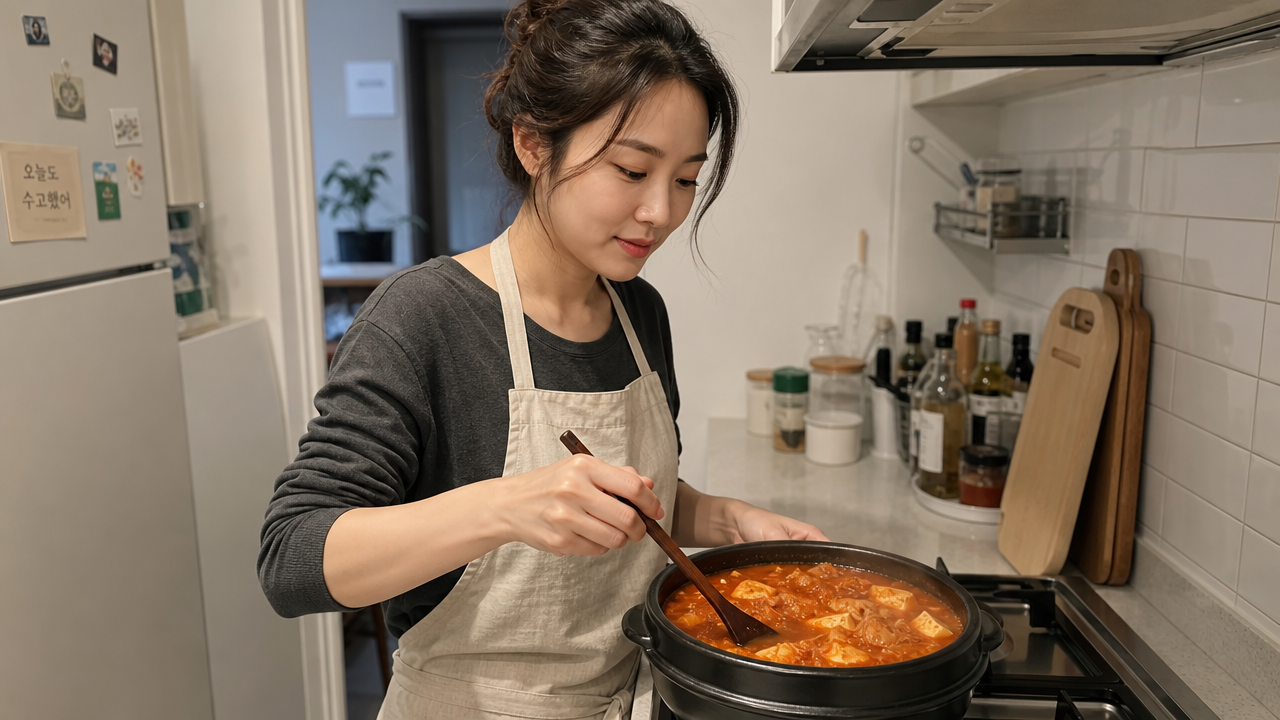
Hi, I’m Jina Moon.
Seoul-born. Now cooking Korean food in a tiny kitchen far from Seoul—and figuring out every substitute the hard way so you don’t have to.
Why I Started This Korean Food Blog
Have you ever paused a K-drama because the bubbling kimchi jjigae looked too good—then closed the recipe because it asked for saeujeot, dasida, and three kinds of gochugaru you’ve never seen?
That was me for years. I grew up in Seoul where dinner always started with a pot of doenjang-guk simmering on the stove. When I moved abroad, I missed that food in my bones. My first “Korean market” was a two-hour bus ride away, and half the labels were only in Korean. I burned doenjang, bought the wrong gochujang (way too sweet), and once tried to make kimchi with regular green cabbage. It did not go well.
I started writing down what actually worked: which substitute is okay, which one ruins the dish, and where I finally found the real thing online for a normal price. Friends started texting me photos from grocery aisles—“Is this the right one?”—and K-Food Explained was born.
What You’ll Find Here
This is not another recipe-only site. There are already 10,000 kimchi recipes online. I focus on the part Google and most blogs skip: ingredients, swaps, and where-to-buy guidance for people cooking outside Korea.
🥢 Ingredients & Substitutes
What each ingredient actually does, what it tastes like, and when you can swap it.
Example: Gochujang vs. ssamjang vs. gochugaru—and which substitutions actually work.
🛒 Where to Buy
Products and shopping options in the US, UK, and EU—including Amazon, H Mart, Weee!, and local stores.
Use labels and product details so you don’t buy the wrong item by mistake.
🍳 Korean Kitchen Tools
Honestly tested guidance on what is useful, what is compatible, and what you can skip.
Dolsot, ttukbaegi, rice cookers, kitchen scissors, voltage, and induction checks.
📖 K-Food Culture, Explained
The stories behind the food—why Koreans use scissors, what “banchan” means, and how context changes a meal.
Useful context for readers who love Korean food, travel, and K-dramas.
For an official overview of Korean table settings, banchan, ssam, and restaurant customs, see VISITKOREA’s introduction to Korean food.
Why Trust My Kitchen?
- Korean food is not a hobby—it’s what I grew up eating. I cook it for my family five to six days a week.
- I’ve lived the substitute problem. I spent years cooking in a small apartment abroad with limited ingredients and learned what swaps actually work.
- Every swap and product is bought and tested by me. No studio and no stock photos. Photos are from my kitchen—including the same ttukbaegi I’ve had for eight years.
- I buy everything myself. If I link to Amazon or a Korean grocer, it’s because I’ve ordered from there and paid for it.
- No AI recipes. If I haven’t cooked and tasted it, I don’t publish it.
A Few Things About Me
🍚 Comfort food: kongnamul-guk (soybean sprout soup)—the Korean hangover and bad-day soup.
✂️ Tool I can’t live without: Korean kitchen scissors. Once you cut kimchi and meat with them, you never go back.
🌶️ Confession: I still can’t finish a whole pack of Buldak—and I’m not sorry.
🐶 Kitchen assistant: My dog, who lives under the table waiting for gimbap to fall.
Where to Start: 3 Reader Guides
- Korean Ingredients and Substitutes—learn what products do and build a practical pantry without wasting money.
- Korean Ingredient Substitute Guide—find realistic swaps and learn when there is no close replacement.
- Where to Buy Korean Ingredients—compare shopping options and learn what to check before ordering.
Contact Me
Have a question from the grocery aisle? Email me at [email protected].
I read every email and usually reply within two days. If you’re wondering, “Can I use X instead of Y?” ask me before you waste money.
Sister publication from Seoul: Looking for the same honest, math-first approach to Korean skincare landed prices, shipping thresholds, and import duties? Check out our sister editorial project, Seoul Beauty Diary.
© K-Food Explained · Explaining Korean food for your kitchen, wherever you are.
Not affiliated with any brand mentioned. All opinions are my own.