

Quick answer: Some Korean pots work on induction, but many traditional ones do not. A typical lightweight aluminum ramyeon pot and an earthenware ttukbaegi are not induction-compatible unless the manufacturer has added and clearly labeled a magnetic induction base. This Korean pots induction guide compares ramyeon pots, stainless pots, ttukbaegi, and dolsot. Cast iron, carbon steel, and magnetic stainless steel usually work. The fastest check is to read the product specification and place a magnet against the flat bottom.
Pick your pot in 30 seconds
Everything below this table is detail. If you just want to buy the right pot once, find your cooktop and what you cook most often.
| Your cooktop | What you cook most | Buy this |
|---|---|---|
| Induction | Ramyeon, noodles, fried eggs | Induction-compatible ramyeon pot |
| Gas or coil | Ramyeon, noodles, fried eggs | Traditional thin-gauge ramyeon pot |
| Induction | Stews served at the table | Induction-safe ttukbaegi |
| Induction | Kimchi jjigae, sundubu, four or more servings | Induction-compatible stew pot |
| Induction | One pot for everything | Stainless pot with a magnetic base |
| Any | Serving only — you already own the stove pot | Dolsot bowls |
Not sure your cooktop counts as induction? The magnet test further down takes ten seconds. Links here are affiliate links — as an Amazon Associate I earn from qualifying purchases, at no extra cost to you.
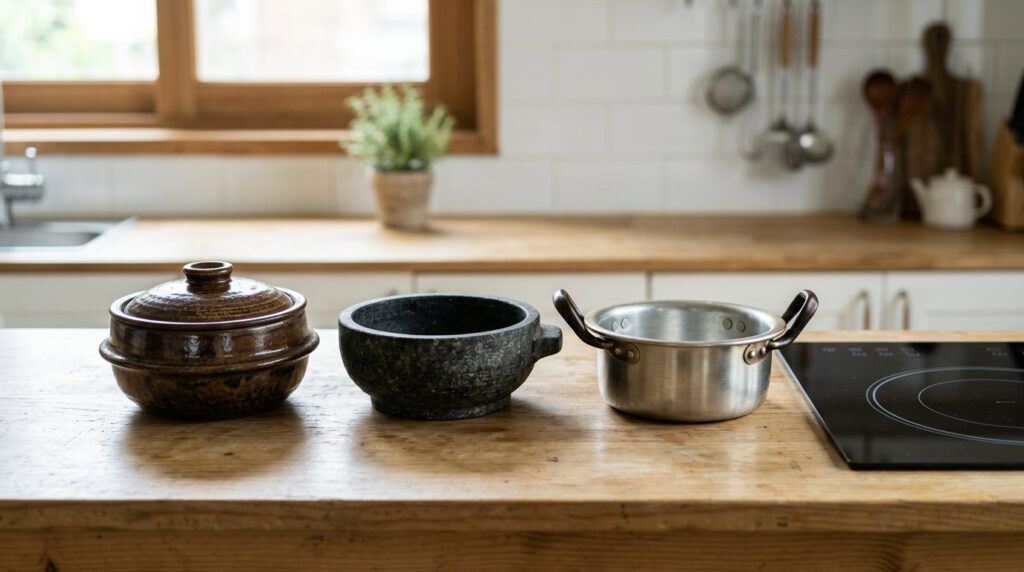
Do not choose by appearance alone: “Stainless steel” does not always mean induction-compatible, and a dark stone or ceramic pot is not magnetic simply because it looks heavy. Confirm the exact product’s induction statement, symbol, base material, and minimum usable diameter.
As an Amazon Associate I earn from qualifying purchases. This page contains affiliate links, which may earn me a small commission at no extra cost to you.
Korean Pots Induction Compatibility Chart
| Korean Pot Type | Typical Material | Induction | Gas | Electric / Glass Top | Best Use |
|---|---|---|---|---|---|
| Yellow ramyeon pot (yang-eun naembi) | Lightweight aluminum | Usually no, unless it has a labeled magnetic base | Usually yes, when the maker says stovetop-safe | Often usable on electric coil; for glass radiant tops, check the maker and keep the base flat | One-pot ramyeon and quick boiling |
| Stainless Korean pot | Single-layer or multi-layer stainless steel | Maybe—only magnetic stainless or a bonded magnetic base works | Usually yes | Usually yes if the base is flat and the maker approves it | Soups, stews, noodles, everyday cooking |
| Ttukbaegi | Glazed earthenware | No on its own | Only when specifically labeled flame-safe | Model-specific; do not assume it is safe on a coil or glass top | Doenjang jjigae, sundubu, gyeran-jjim |
| Dolsot | Natural stone, ceramic, or stone-style material | No on its own; some modern products add a magnetic outer base | Only if the exact model is approved for direct flame | Model-specific; stone can scratch glass and crack from thermal shock | Bibimbap, crispy rice, serving hot food |
| Cast-iron Korean pot | Cast iron or enameled cast iron | Yes in most cases | Yes | Usually yes; lift rather than slide on glass | Stews, braises, rice, heat retention |
| Carbon-steel pot or wok | Carbon steel | Usually yes if the base is flat and large enough | Yes | Flat-bottom models are best | Stir-frying and high-heat cooking |
| Coated aluminum pot | Aluminum with nonstick coating | Only if it has a bonded magnetic base and induction label | Usually yes within the maker’s heat limit | Usually yes if approved and flat | Lightweight everyday cooking |
| Enameled steel pot | Steel coated with enamel | Usually yes, but confirm the model | Usually yes | Usually yes; protect enamel and glass from impacts | Ramyeon, soup, hot pot |
The chart describes common construction, not every product. Manufacturing varies, so the exact model’s instructions always take priority.
The 10-Second Induction Magnet Test
- Turn the empty pot upside down.
- Place a refrigerator magnet against the flat center of the outside bottom.
- If it grips firmly, the base is likely suitable for induction.
- If it barely sticks, slides off, or does not stick, expect poor heating or no detection.
- Confirm the result by finding “induction compatible,” “IH,” or the coil-shaped induction symbol in the manufacturer’s specifications.
A strong magnet result is a useful screening test, but it is not the only requirement. A pot can still fail if its bottom is too small, warped, rounded, or outside the cooktop’s detection range. Check your cooktop manual for the minimum pan diameter and approved materials.
Easy buying rule: Before ordering online, find all three: (1) an explicit induction statement, (2) the bottom diameter, and (3) the exact material or base construction. A product title that only says “Korean stainless pot” is not enough.
Korean Pots Induction FAQ
Which Korean pots induction cooktops actually accept?
Any Korean pot with a magnetic base: cast iron, carbon steel, and magnetic stainless steel. For Korean pots, induction compatibility is a property of the base, not the brand — two identical-looking pots can behave differently.
Why does my Korean pot beep or heat unevenly on induction?
Usually the base is too small, warped, or rounded for the cooktop’s detection zone. This is the most common complaint in Korean pots induction discussions, and the fix is a flat, magnetic base at least as wide as the burner ring (see how induction cooking works).
Should I just buy an induction-safe Korean pot set?
If you cook Korean food weekly, yes — a magnetic stainless Korean pot set removes the guesswork from Korean pots induction shopping and usually costs less than replacing ttukbaegi one by one.
Shipping on pots and appliances varies a lot by country. where these ship from, by country is worth a look before you order.
Will a Korean Ramyeon Pot Work on Induction?
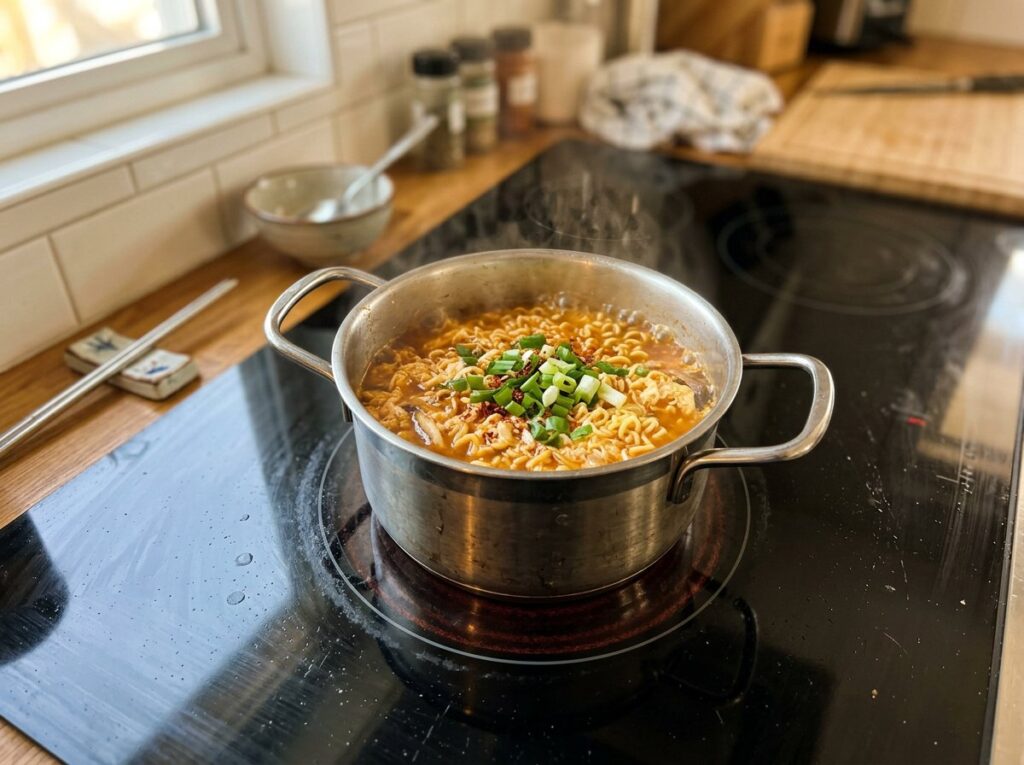
The classic yellow Korean ramyeon pot—often called a yang-eun naembi—is usually made from thin aluminum. Aluminum heats quickly and keeps the pot light, but plain aluminum is not magnetic. That means a traditional version normally will not activate an induction burner.
Some newer ramyeon pots add a magnetic stainless-steel plate to the bottom. Those models can work on induction when the manufacturer explicitly says so. Do not assume that every yellow pot has this base: flip it over, inspect the bottom, perform the magnet test, and check the listing.
Amazon · Stainless induction ramyeon pot →
Amazon · Classic aluminum ramyeon pot (not induction) →
Buying warning: Amazon search results can contain both compatible and incompatible pots. Verify the exact item, size, and base shown on the product page.
Does a Stainless Korean Pot Work on Induction?
Sometimes. Stainless steel is a family of alloys, and not every stainless composition is magnetic. Many modern pots solve this with a bonded magnetic layer on the outside bottom. The pot may contain aluminum inside for even heat distribution while still having an induction-ready steel exterior.
Ignore vague claims such as “premium stainless.” Look for the words “induction compatible,” a coil symbol, or a clearly described magnetic base. Then use the magnet test when the pot arrives.
Amazon · Tri-ply stainless pot, magnetic base · 3.5 qt →
Can You Use a Ttukbaegi on Induction?
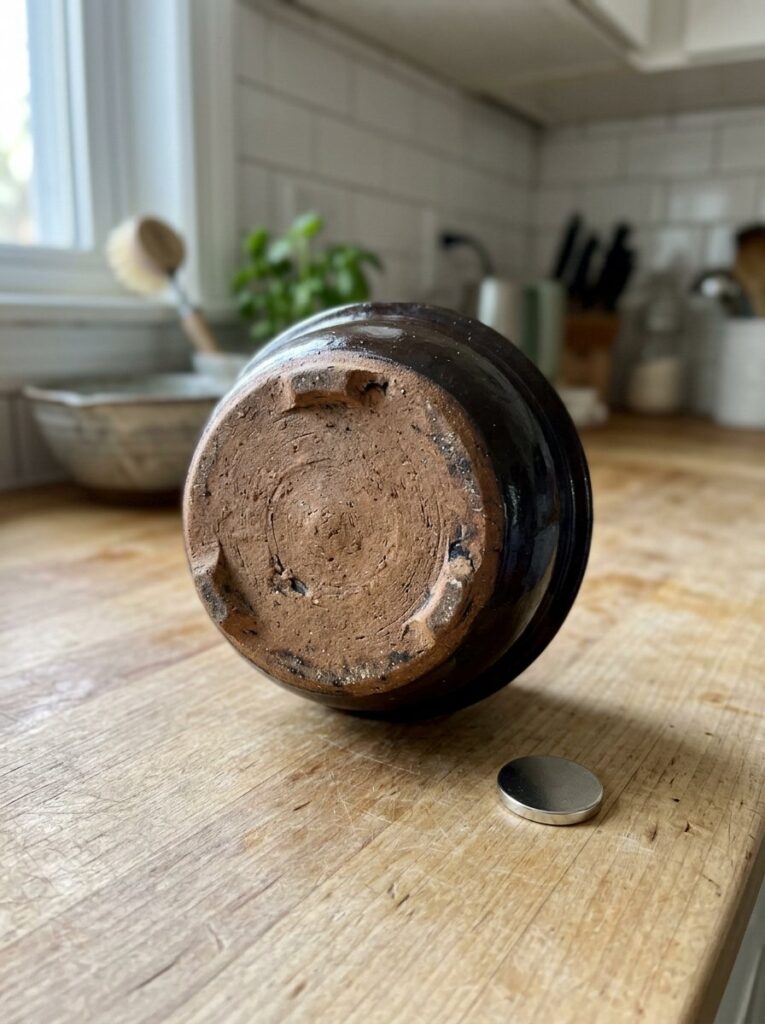
A traditional ttukbaegi is glazed earthenware, so it is not magnetic and will not heat directly on a standard induction cooktop. It is commonly used for bubbling Korean stews because the thick clay retains heat after leaving the stove.
Do not place a ttukbaegi over direct flame unless its manufacturer says it is flame-safe. Do not move a cold pot directly to high heat or place a very hot pot on a cold or wet surface. Rapid temperature changes can crack earthenware. Heat gradually and follow the maker’s first-use, cleaning, and drying instructions.
An induction interface disk can heat some nonmagnetic cookware indirectly, but it reduces the speed and efficiency advantages of induction and can become extremely hot. Some cooktop manufacturers restrict or discourage these disks. Check both the cooktop and ttukbaegi instructions before considering one; the simpler solution is an induction-compatible metal pot.
Amazon · Clay ttukbaegi · 4 × 17 oz (not induction) →
Amazon · Induction-ready stone-style pot · 7 in →
Amazon · Induction-ready stew pot · 72 oz →
Can You Use a Dolsot on Induction?
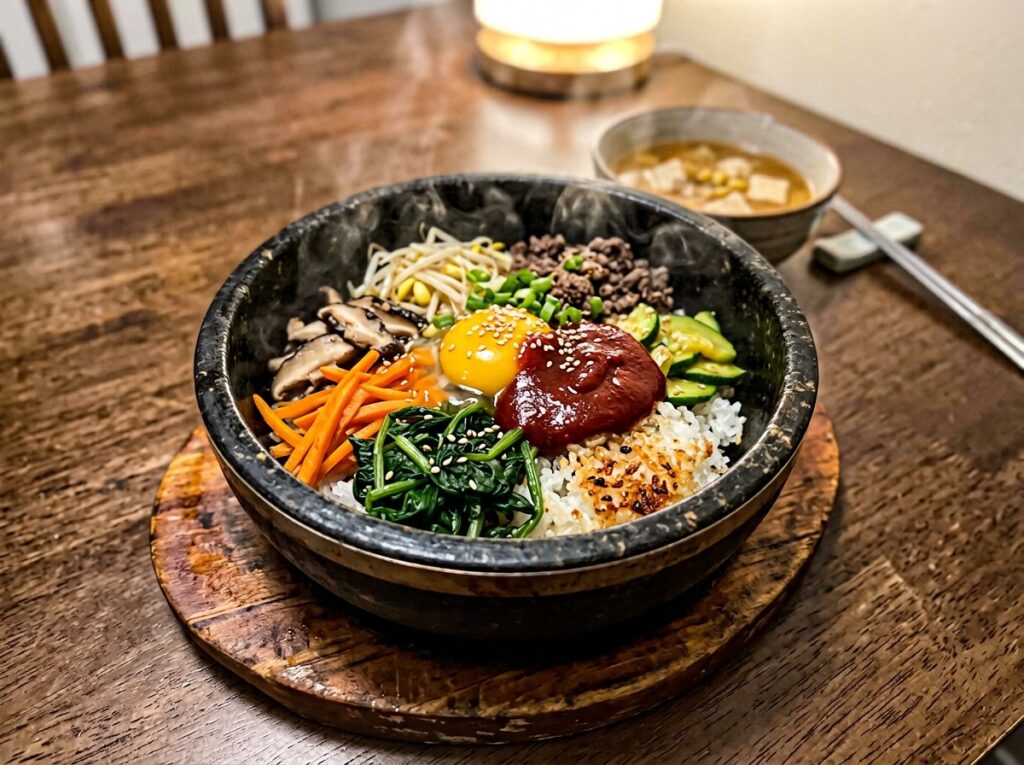
A traditional stone or ceramic dolsot is not magnetic, so it does not work directly on induction. A modern “dolsot-style” bowl may have a metal exterior or magnetic base, but that is a different construction and must be labeled for induction.
Natural stone also needs careful heating. Follow the seller’s seasoning and preheating directions, avoid thermal shock, and never assume that an oven-safe serving bowl is stovetop-safe. On a glass cooktop, lift heavy stone or cast iron rather than sliding it to reduce scratching.
Amazon · Ceramic dolsot with lid · medium →
Amazon · Cast-iron bibimbap pot, induction-ready · 18 cm →
The cast-iron pot ships from Amazon Japan, so delivery can take longer; the ceramic dolsot is not for induction.
Korean Pot Size Guide
| Approximate Diameter | Best For | Typical Portion | Compatibility Detail |
|---|---|---|---|
| 12–14 cm / 4.7–5.5 in | Egg dishes, sauces, small ttukbaegi | Single side dish | May be too small for some induction zones to detect |
| 14–16 cm / 5.5–6.3 in | Single-serving jjigae or dolsot bibimbap | One person | Check the flat bottom diameter, not the widest rim |
| 16–18 cm / 6.3–7.1 in | Ramyeon, small soup, stew | One to two people | A practical small-pot size, but induction still requires a magnetic base |
| 20–22 cm / 7.9–8.7 in | Family jjigae, hot pot, noodles | Two to four people | Match the bottom to the burner zone for even heating |
| 24 cm+ / 9.4 in+ | Large hot pot, entertaining | Four or more people | Check weight, storage, burner size, and handle clearance |
Sizes vary by shape and manufacturer. Capacity in liters or quarts is more useful than rim diameter when comparing deep pots. For induction, the flat magnetic area touching the cooktop matters more than the width across the top.
Material, Weight, and Care
| Material | Main Advantage | Main Limitation | Care Note |
|---|---|---|---|
| Aluminum | Very light and heats quickly | Not induction-ready without a magnetic base; can dent or warp | Avoid overheating an empty thin pot; follow coating instructions |
| Stainless steel | Durable and low-maintenance | Induction compatibility varies; thin pots may heat unevenly | Use the magnet test and check for a layered base |
| Earthenware | Excellent heat retention and table presentation | Heavy, breakable, not directly induction-compatible | Heat gradually and avoid thermal shock |
| Natural stone | Creates crisp rice and holds heat | Very heavy; can crack; not directly induction-compatible | Season and preheat only as directed |
| Cast iron | Excellent induction response and heat retention | Heavy and can scratch glass if dragged | Lift it; dry and season bare iron |
| Enameled steel or iron | Magnetic, colorful, and relatively easy to clean | Enamel can chip after impact | Avoid metal impacts and sudden temperature change |
12 Things to Check Before Buying Korean Pots
- Exact material, not just color or style
- Explicit “induction compatible” statement when needed
- Induction coil symbol or IH marking
- Flat bottom diameter
- Your cooktop’s minimum pan size
- Capacity in liters or quarts
- Total weight when filled
- Handle material and whether it becomes hot
- Lid material and steam vent
- Maximum stovetop or oven temperature
- Dishwasher instructions
- Return policy if your induction cooktop does not detect it
Frequently Asked Questions
Are all stainless steel Korean pots induction-compatible?
No. Only pots with a sufficiently magnetic stainless exterior or bonded magnetic base will work. Check the manufacturer’s claim and perform the magnet test on the outside bottom.
Why will my small Korean pot not activate the induction burner?
The material may be magnetic but the flat bottom may be smaller than the cooktop’s detection limit. It may also be off-center, warped, or only weakly magnetic. Check the cooktop manual for its minimum diameter.
Can I put a ttukbaegi directly on an electric coil?
Only if the ttukbaegi manufacturer specifically approves that heat source. Earthenware formulas and glazes vary. Begin with gradual heat and avoid moving a cold pot directly onto a very hot element.
Can I use an induction adapter plate under a ttukbaegi?
Possibly, but not automatically or on every cooktop. Adapter disks become very hot, reduce efficiency, and may be restricted by the cooktop manufacturer. Both the cookware and cooktop instructions must allow the setup. An induction-compatible metal stew pot is the simpler choice.
Is the classic yellow Korean ramyeon pot safe?
Use a food-contact product from a reputable seller and follow its heat, utensil, cleaning, and coating instructions. Replace a pot that is badly warped, deeply scratched, peeling, or otherwise damaged. Its yellow color does not tell you whether it is induction-compatible.
Bottom Line
For induction, choose a Korean pot with a flat magnetic base and an explicit induction-compatible statement. Traditional aluminum ramyeon pots, earthenware ttukbaegi, and stone dolsot generally do not work directly. Magnetic stainless steel, cast iron, carbon steel, and specially constructed induction-ready pots do. When in doubt, check the exact model, use a magnet, and compare the bottom diameter with your cooktop manual.
Next read: Browse Korean Kitchen Tools →
Reference
For a general explanation of induction materials and the magnet test, see All-Clad’s induction cookware guide. Product construction varies, so always follow the exact cookware and cooktop manufacturer instructions.
This guide provides general compatibility and buying information. Product materials, cooktops, and manufacturer instructions vary. Stop using cookware that cracks, warps, peels, or becomes unstable.
Shop These 8 Korean Pots on Amazon
Already picked your pot? Here are the same eight pots in one list. Each button adds that one item to your Amazon cart, where you can review or remove it. Check the base and size on the listing before checkout.
Amazon — 8 items
1. AMAZON US Prime members may see free two-day delivery on eligible items and addresses; check the listing and checkout.
Stainless induction ramyeon pot, glass lid → AHIER classic aluminum ramyeon pot · 6.3 in (gas/electric, not induction) → Induction-ready cast-aluminum stone-style pot · 7 in → Induction-ready cast-aluminum stew pot · 72 oz → Delarlo tri-ply stainless pot, magnetic base · 3.5 qt → Clay ttukbaegi set · 4 × 17 oz (not induction) → Crazy Korean Cooking ceramic dolsot with lid · medium → Ishigaki cast-iron bibimbap pot, induction-ready · 18 cm →
Pots marked “not induction” are for gas or electric coil stoves only. Use the magnet test above if you are unsure about your cooktop.
Shopping from outside the US? Compare local availability and the final delivered price with our Korean grocery shopping guide.
