
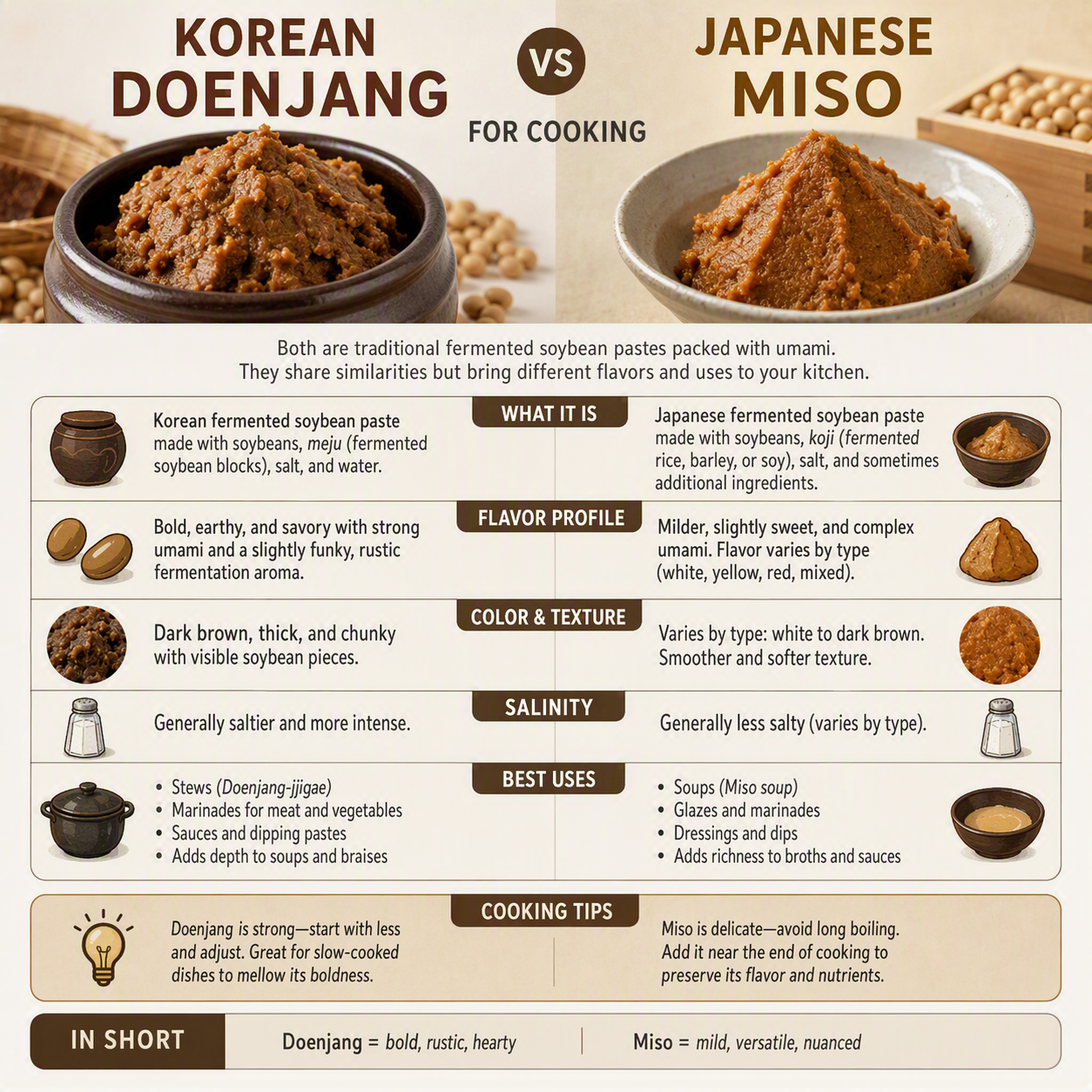
Is doenjang the same as miso? It’s the question I answer more than any other — and the short answer is no. Here’s the full breakdown.
I get this question more than almost any other — usually from someone standing in an Asian grocery aisle with a red-brown tub in each hand, squinting at the labels.
“Jina, is doenjang just… Korean miso?”
I understand why people ask. They sit in the same section of the fridge. They’re both brown, both fermented, both made from soybeans. But I grew up cooking with doenjang and later fell hard for miso in my own kitchen, and I can tell you: they are cousins, not twins. Same family, very different personalities.
Quick Answer: Is Doenjang the Same as Miso?
No. Doenjang and miso are both fermented soybean pastes, but they’re made differently, taste differently, and I use them for different jobs. The three biggest differences:
- How they’re made: Doenjang is soybeans + salt + water, fermented slowly in big earthenware pots. Miso is soybeans + koji (a cultured grain) + salt.
- Flavor: Doenjang is deeper, saltier, earthier — almost funky. Miso is smoother, milder and a little sweet, with a soft, round umami.
- Texture: Doenjang is chunky and rustic. Miso is fine and creamy.
If you’re in a hurry: red miso is the closest thing to doenjang, and for soups and stews you can swap them 1:1 in a pinch — just add a pinch of salt. But for a proper doenjang jjigae (된장찌개), miso alone won’t get you there. Let me explain why.
What Doenjang Actually Is
Doenjang starts with meju — blocks of cooked, crushed soybeans that are dried and hung to ferment. In Korea, my grandmother’s generation did this at home; the meju blocks would sit on the hangari (옹기, the big earthenware pots) through the seasons, and the whole process could take months.
The result is a paste that’s intense: deeply savory, salty, a little funky, with a texture that still has bits of soybean in it. It’s the backbone of Korean cooking — doenjang jjigae, ssamjang, marinades, and that habit Koreans have of adding a spoon to all sorts of stews to deepen them.
What Miso Actually Is
Miso is also fermented soybeans, but the key difference is koji — a cultured grain (usually rice or barley) that’s added to the beans. The koji brings enzymes that break things down faster and produce that sweet, rounded, almost fruity umami. That’s why miso feels “softer” than doenjang.
Depending on the koji and fermentation time you get white (shiro) miso, yellow, or red (aka) miso. Red miso is fermented longest and is the most intense — which is why it’s the one I reach for when I want a doenjang-like depth.
Doenjang vs Miso: Side by Side
| Doenjang (된장) | Miso (味噌) | |
|---|---|---|
| Origin | Korean | Japanese |
| Fermentation starter | Soybeans + salt + water (traditional) | Soybeans + koji (rice/barley) + salt |
| Fermentation time | Months to years | Weeks to months (longer = darker/stronger) |
| Flavor | Salty, earthy, deep, funky | Milder, sweeter, round umami |
| Texture | Chunky, rustic | Smooth, creamy |
| Color | Deep brown | White to dark brown (red miso closest to doenjang) |
| Best for | Jjigae, ssamjang, marinades, Korean stews | Miso soup, glazes, dressings, marinades |
| Gluten | Traditionally gluten-free (check label) | Rice miso is GF; barley (mugi) miso contains gluten |
Sempio Korean doenjang · 460 g tub (Amazon) → · Sempio vegan doenjang · 460 g tub (iHerb 5% off) → · CJ Haechandle doenjang · 1.1 lb tub (Instacart) →
Eden Foods organic genmai brown rice miso · 12.1 oz (iHerb 5% off) → · Eden Foods organic brown rice miso · 12.1 oz (Amazon) →
Can You Swap Them 1:1? My Rule
Yes, but with conditions. Here’s the rule I actually cook by:
- For soups and stews: Swap 1:1. Use red miso, and add a small pinch of salt (miso is less salty than doenjang). It won’t taste identical, but it will be delicious.
- For ssamjang or dipping sauces: Miso works in a pinch, but you lose the funky punch. Add a tiny bit of gochujang and garlic to wake it up.
- For marinades: They’re almost interchangeable here — both bring salt and umami. I actually mix them sometimes on purpose.
When I Would NOT Swap Them
- Doenjang jjigae (된장찌개). The whole point is that deep, fermented, almost sharp soybean flavor. White or yellow miso will make a flat, sweet soup. Even red miso is a compromise — fine for dinner, but it’s not jjigae.
- Miso glazes and dressings. Doenjang will overpower the delicate sweetness of a miso-honey glaze. If that’s all you have, use half the amount and add a little honey.
- Delicate miso soup. Doenjang would be too aggressive. You can make a Korean-style soup with it, but it won’t be Japanese miso soup.
How I Actually Use Both in a Normal Week
Here’s a real peek into my kitchen, because this is the most practical answer:
- Doenjang: jjigae two or three times a week, ssamjang for lettuce wraps, and a spoonful in my guk (soup) whenever it tastes “flat.”
- Red miso: quick 5-minute miso soup when I’m tired, miso-honey salmon, and salad dressings.
- Both together: in a beef or pork marinade — sounds odd, tastes incredible.
If you can only buy one: buy the real doenjang. It’s the more versatile of the two for Korean cooking, and it’s what most readers are actually trying to cook.
How to Tell Them Apart on the Shelf
Labels help more than you’d think. Doenjang tubs say “doenjang” or “Korean soybean paste”; miso says “miso” or “soybean paste” with a koji ingredient listed. If you’re reading a Korean label, my guide on how to read Korean food labels will help, and my where-to-buy guide has the exact products I order — with label photos, so you don’t buy the wrong one.
→ Internal link: Where to Buy Korean Ingredients Online (with label photos) | How to Read Korean Food Labels
FAQs
Is doenjang healthier than miso?
Both are fermented foods with probiotics and protein. Doenjang is typically saltier per spoon, so portion matters. Neither is “healthier” overall — I treat both as flavorful, fermented staples.
Is red miso the same as doenjang?
Not the same, but the closest miso to doenjang. Red miso is fermented longer, so it’s deeper and saltier than white miso. Still smoother and a little sweeter than real doenjang.
Can I substitute doenjang for miso in miso soup?
You can, but the soup will be more intense and less delicate. Use about half the amount, add more dashi or broth, and taste as you go. It becomes “Korean-style soybean soup” — good, just different.
My Final Word: Is Doenjang the Same as Miso?
Doenjang and miso look like they could be the same product from two countries. They’re not. Treat doenjang as the deep, bold workhorse of Korean cooking, and miso as the softer, sweeter all-rounder — and if you only remember one thing from this post, remember this: when a Korean recipe says doenjang, use doenjang. When you can’t find it, red miso plus a pinch of salt will save your dinner. I’ve done it plenty of times.
Still not sure is doenjang the same as miso? Buy both, taste them side by side, and you’ll never forget the difference.
Once you have picked one, the pot matters too — especially on induction, where a lot of traditional Korean cookware simply will not heat.
Buying anything chilled or frozen? Check which stores will ship chilled items to you before you fill a cart.
Shop These Doenjang & Miso Staples by Store
Amazon (Prime delivery & 90-day cart guarantee)
Sempio Korean doenjang · 460 g tub → · CJ Haechandle doenjang soybean paste · 500 g tub → · Eden Foods organic genmai brown rice miso · 12.1 oz →
iHerb (Direct global delivery & 5% rewards discount with code PNF305)
Sempio vegan doenjang · 460 g tub (5% OFF with code PNF305) → · Eden Foods organic genmai miso · 12.1 oz (5% OFF with code PNF305) →
Instacart (Same-day local Korean & Asian market delivery)
CJ Haechandle doenjang · 1.1 lb tub → · Sempio doenjang soybean paste · 460 g tub →
