
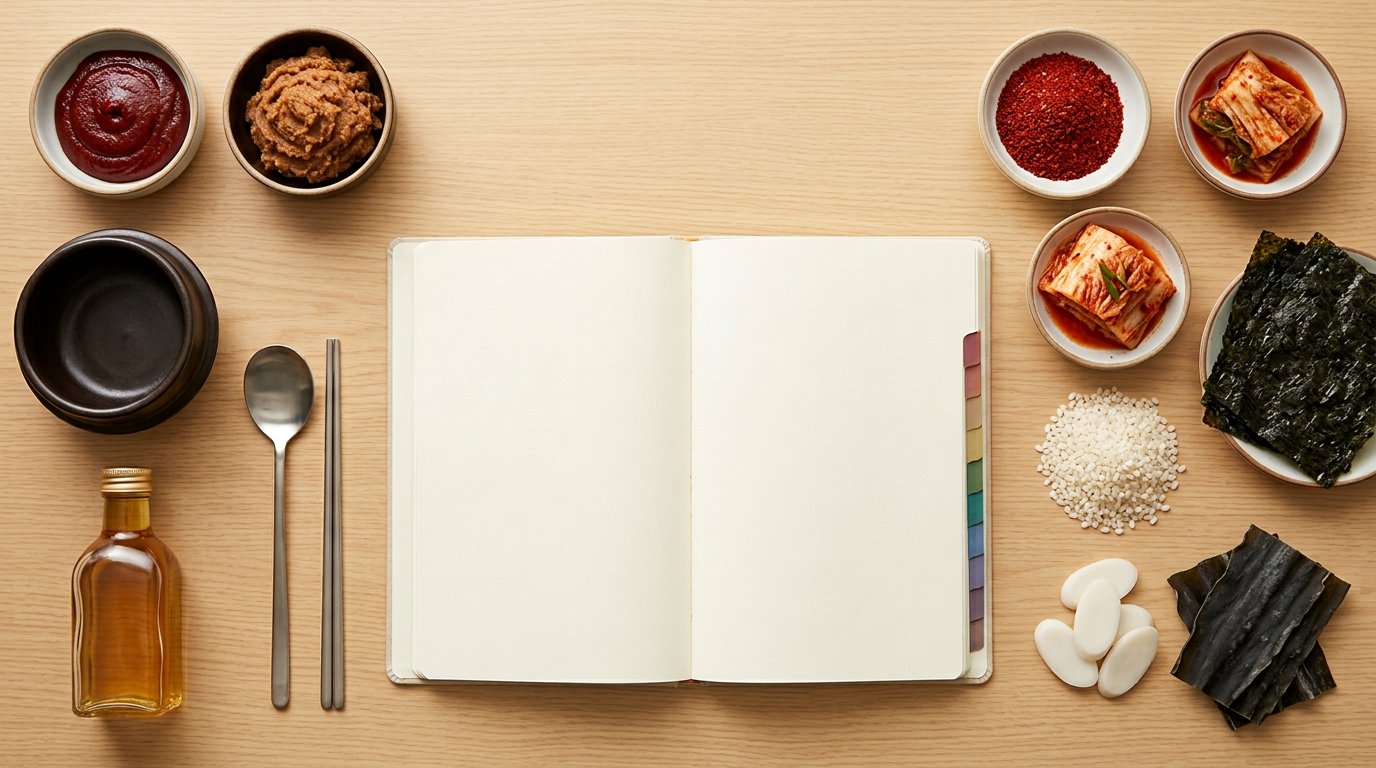
Korean food terms can be confusing even when the English translation looks simple. This Korean food glossary explains 45 essential ingredients, dishes, cooking words, and kitchen tools with Hangul, an easy pronunciation guide, examples, common mix-ups, and links showing where to buy or learn more.
How to use this page: Select a letter below or use your browser’s Find command. Each definition starts with a direct answer to questions such as “What is gochujang?” and “What is banchan?” Pronunciations are simple English approximations, not exact linguistic transcriptions.
As an Amazon Associate I earn from qualifying purchases. This page contains affiliate links, which may earn me a small commission at no extra cost to you.
A · B · C · D · F · G · H · J · K · M · N · O · R · S · T · U
A
What Is Aekjeot (액젓)?
Pronunciation: EH-jut · Category: Ingredient
Aekjeot is Korean fermented fish sauce used to add salt and deep savory flavor to kimchi, soups, and seasoned vegetables.
- Used in or with: napa-cabbage kimchi, radish kimchi, soup seasoning.
- Do not confuse it with: It is a clear liquid; saeujeot contains visible salted shrimp.
Where to buy or learn more: Find Korean fish sauce on Amazon →
B
What Is Banchan (반찬)?
Pronunciation: BAHN-chahn · Category: Food Culture
Banchan are the small shared side dishes served with rice at a Korean meal. A table may have one simple side dish or many different vegetables, proteins, and pickles.
- Used in or with: kimchi, namul, braised potatoes, seasoned fish cakes.
- Do not confuse it with: Banchan describes a role in the meal, not one specific recipe.
Where to buy or learn more: Explore Korean food culture →
What Is Bap (밥)?
Pronunciation: bahp · Category: Food And Language
Bap most often means cooked rice, but it can also mean a meal in everyday Korean speech.
- Used in or with: plain rice, bibimbap, gimbap, mixed-grain rice.
- Do not confuse it with: Uncooked rice is ssal; cooked rice is bap.
Where to buy or learn more: Find Korean short-grain rice on Amazon →
What Is Bibimbap (비빔밥)?
Pronunciation: BEE-bim-bahp · Category: Dish
Bibimbap is rice topped with separately prepared vegetables and often egg or meat, then mixed with a seasoned sauce before eating.
- Used in or with: rice, namul, egg, beef, gochujang sauce.
- Do not confuse it with: The gochujang sauce is usually seasoned and thinner than paste straight from the tub.
Where to buy or learn more: Find bibimbap sauce on Amazon →
What Is Bokkeum (볶음)?
Pronunciation: BOHK-keum · Category: Cooking Term
Bokkeum means a stir-fried or sautéed dish cooked with a relatively small amount of liquid.
- Used in or with: kimchi-bokkeum, ojingeo-bokkeum, myeolchi-bokkeum.
- Do not confuse it with: Bokkeum is stir-fried; jorim is simmered or braised in seasoning.
Where to buy or learn more: Explore Korean cooking terms →
What Is Bulgogi (불고기)?
Pronunciation: bool-GOH-gee · Category: Dish
Bulgogi is thinly sliced meat marinated in a sweet-savory soy-based seasoning and then grilled or pan-cooked. Beef is the best-known version, but the word can appear in other seasoned meat dishes.
- Used in or with: rice bowls, lettuce wraps, Korean barbecue meals.
- Do not confuse it with: Bulgogi is usually marinated; samgyeopsal is commonly cooked unseasoned at the table.
Where to buy or learn more: Find bulgogi marinade on Amazon →
C
What Is Chamgireum (참기름)?
Pronunciation: chahm-GEE-reum · Category: Ingredient
Chamgireum is Korean toasted sesame oil. It is used in small amounts for aroma and as a finishing seasoning rather than as a neutral deep-frying oil.
- Used in or with: bibimbap, namul, dipping sauce, marinades.
- Do not confuse it with: Toasted sesame oil is darker and more aromatic than untoasted sesame oil.
Where to buy or learn more: Find Korean sesame oil on Amazon →
D
What Is Dasida (다시다)?
Pronunciation: dah-SHEE-dah · Category: Ingredient
Dasida is a Korean seasoning brand name commonly used to refer to concentrated stock powder, especially beef-flavored soup seasoning.
- Used in or with: soups, stews, noodle broth, quick seasoning.
- Do not confuse it with: It is stock powder, not dashima, the Korean word for dried kelp.
Where to buy or learn more: Find dasida on Amazon →
What Is Dashima (다시마)?
Pronunciation: dah-SHEE-mah · Category: Ingredient
Dashima is dried kelp used to make clean, savory Korean broth. Japanese kombu is the closest commonly available equivalent.
- Used in or with: anchovy-kelp stock, soups, stews, braises.
- Do not confuse it with: Remove it before prolonged hard boiling if you want a clean broth without excessive thickness or bitterness.
Where to buy or learn more: Find dashima on Amazon →
What Is Doenjang (된장)?
Pronunciation: DWEHN-jahng · Category: Ingredient
Doenjang is a thick Korean fermented soybean paste with an earthy, salty, deeply savory flavor.
- Used in or with: doenjang-jjigae, soup, vegetable seasoning, ssamjang.
- Do not confuse it with: Japanese miso is generally smoother, sweeter, and milder.
Where to buy or learn more: Read the doenjang substitute guide →
What Is Dolsot (돌솥)?
Pronunciation: DOHL-soht · Category: Kitchen Tool
Dolsot means a stone pot or stone bowl that retains high heat and can create a crisp layer of rice.
- Used in or with: dolsot-bibimbap, hot rice, serving bubbling dishes.
- Do not confuse it with: Dolsot is stone; ttukbaegi is earthenware. Traditional stone is not directly induction-compatible.
Where to buy or learn more: Check Korean pot compatibility →
F
What Is Fermentation (발효 (balhyo))?
Pronunciation: bahl-HYO · Category: Food Process
Fermentation in Korean food uses microorganisms and time to transform ingredients, developing acidity, aroma, preservation, and savory depth.
- Used in or with: kimchi, doenjang, gochujang, ganjang, jeotgal.
- Do not confuse it with: Fermented does not automatically mean probiotic after cooking, pasteurization, or long storage.
Where to buy or learn more: Explore Korean fermentation culture →
G
What Is Ganjang (간장)?
Pronunciation: GAHN-jahng · Category: Ingredient
Ganjang is the general Korean word for soy sauce. Different types vary in color, salt level, fermentation, and intended use.
- Used in or with: marinades, dipping sauces, braises, stir-fries.
- Do not confuse it with: Guk-ganjang is a lighter-colored, saltier soup soy sauce; regular brewed soy sauce is used more broadly.
Where to buy or learn more: Find Korean soy sauce on Amazon →
What Is Gim (김)?
Pronunciation: geem · Category: Ingredient
Gim is Korean edible seaweed, often roasted and seasoned with oil and salt or sold as plain full-size sheets.
- Used in or with: rice, snacks, gimbap, garnish.
- Do not confuse it with: Japanese nori is closely related, but snack gim may be oilier and saltier than plain sushi nori.
Where to buy or learn more: Find Korean gim on Amazon →
What Is Gimbap (김밥)?
Pronunciation: GEEM-bahp · Category: Dish
Gimbap is a Korean seaweed rice roll filled with seasoned vegetables and proteins. The rice is commonly seasoned with sesame oil and salt.
- Used in or with: picnics, lunch boxes, convenience-store meals.
- Do not confuse it with: Gimbap is not simply Korean sushi; it usually does not use vinegared sushi rice or raw fish as its defining ingredients.
Where to buy or learn more: Find gimbap seaweed on Amazon →
What Is Gochugaru (고춧가루)?
Pronunciation: GOH-choo-gah-roo · Category: Ingredient
Gochugaru is Korean red pepper powder or flakes with a fruity, warm heat and vivid red color.
- Used in or with: kimchi, spicy soups, banchan, gochujang-based sauces.
- Do not confuse it with: It is usually less sharp than cayenne; fine and coarse grinds are used differently.
Where to buy or learn more: Find gochugaru on Amazon →
What Is Gochujang (고추장)?
Pronunciation: GOH-choo-jahng · Category: Ingredient
Gochujang is a thick Korean fermented chili paste that combines heat, sweetness, salt, and savory depth.
- Used in or with: tteokbokki, bibimbap sauce, marinades, stews.
- Do not confuse it with: Traditional paste in a tub is more concentrated than bottled gochujang sauce; it is also different from ssamjang.
Where to buy or learn more: Read the gochujang substitute guide →
What Is Gui (구이)?
Pronunciation: goo-EE · Category: Cooking Term
Gui refers to a grilled or roasted dish, including meat, fish, shellfish, and vegetables.
- Used in or with: galbi-gui, saengseon-gui, grilled mushrooms.
- Do not confuse it with: Gui describes the cooking style; Korean barbecue is one familiar category within it.
Where to buy or learn more: Explore Korean food culture →
What Is Guk (국)?
Pronunciation: gook · Category: Dish Category
Guk is a Korean soup, usually served with rice as part of an everyday meal.
- Used in or with: miyeok-guk, kongnamul-guk, beef radish soup.
- Do not confuse it with: Guk is generally more broth-forward than jjigae, although real household usage can overlap.
Where to buy or learn more: Find Korean soup ingredients on Amazon →
What Is Guk-ganjang (국간장)?
Pronunciation: GOOK-gahn-jahng · Category: Ingredient
Guk-ganjang is Korean soup soy sauce: salty and savory but lighter in color than common dark soy sauces.
- Used in or with: clear soups, namul, broth seasoning.
- Do not confuse it with: Regular soy sauce can darken a soup and may taste sweeter.
Where to buy or learn more: Find soup soy sauce on Amazon →
H
What Is Hansik (한식)?
Pronunciation: HAHN-sheek · Category: Food Culture
Hansik means Korean cuisine or a Korean-style meal. It includes everyday home cooking, regional dishes, temple food, royal cuisine, street food, and modern cooking.
- Used in or with: restaurant categories, cultural discussions, complete Korean meals.
- Do not confuse it with: Hansik is broader than barbecue, kimchi, or any single famous dish.
Where to buy or learn more: Explore Korean food culture →
J
What Is Jang (장)?
Pronunciation: jahng · Category: Ingredient Category
Jang is a family of Korean fermented seasonings, especially ganjang, doenjang, and gochujang.
- Used in or with: soups, marinades, dipping sauces, kimchi seasoning.
- Do not confuse it with: The word describes a seasoning category, not one specific sauce.
Where to buy or learn more: Browse Korean pantry ingredients →
What Is Japchae (잡채)?
Pronunciation: JAHP-chae · Category: Dish
Japchae is a Korean dish of chewy sweet-potato starch noodles stir-fried and mixed with vegetables, mushrooms, and often beef.
- Used in or with: holiday meals, parties, banchan, lunch boxes.
- Do not confuse it with: Dangmyeon noodles are different from wheat pasta and softer mung-bean glass noodles.
Where to buy or learn more: Find japchae noodles on Amazon →
What Is Jeongol (전골)?
Pronunciation: JUHN-gohl · Category: Dish Category
Jeongol is a Korean communal hot pot in which arranged ingredients cook together in broth at the table or just before serving.
- Used in or with: mushroom jeongol, beef jeongol, dumpling hot pot.
- Do not confuse it with: Jeongol is usually more abundant and table-centered than everyday jjigae.
Where to buy or learn more: Find Korean-style hot pots on Amazon →
What Is Jeotgal (젓갈)?
Pronunciation: JUHT-gahl · Category: Ingredient Category
Jeotgal is a category of salted and fermented seafood used as a condiment or seasoning.
- Used in or with: kimchi, rice meals, dipping, regional banchan.
- Do not confuse it with: Jeotgal includes many products; saeujeot is the shrimp variety and aekjeot is liquid fish sauce.
Where to buy or learn more: Search for Korean jeotgal →
What Is Jeotgarak (젓가락)?
Pronunciation: JUHT-gah-rahk · Category: Tableware
Jeotgarak are chopsticks. Korean place settings commonly use metal chopsticks alongside a spoon.
- Used in or with: everyday meals, barbecue, banchan.
- Do not confuse it with: Jeotgarak means chopsticks; sujeo means the spoon-and-chopstick set.
Where to buy or learn more: Find Korean chopsticks on Amazon →
What Is Jjigae (찌개)?
Pronunciation: JJEE-geh · Category: Dish Category
Jjigae is a strongly seasoned Korean stew commonly shared or served bubbling hot with rice.
- Used in or with: kimchi-jjigae, doenjang-jjigae, sundubu-jjigae.
- Do not confuse it with: Jjigae is usually thicker, saltier, and less broth-heavy than guk.
Where to buy or learn more: Find Korean stew pots on Amazon →
K
What Is Kimchi (김치)?
Pronunciation: GEEM-chee · Category: Food Category
Kimchi is a broad category of Korean vegetables salted and seasoned for fermentation or fresh eating. Napa cabbage kimchi is famous, but radish, cucumber, and many other varieties exist.
- Used in or with: banchan, fried rice, stews, noodles.
- Do not confuse it with: Kimchi is a category, not one fixed recipe, and not every variety is equally sour or spicy.
Where to buy or learn more: See store-bought kimchi recommendations →
What Is Kimjang (김장)?
Pronunciation: GEEM-jahng · Category: Food Culture
Kimjang is the communal tradition of preparing and sharing large quantities of kimchi, historically for the winter months.
- Used in or with: late-autumn cabbage preparation, family and community gatherings.
- Do not confuse it with: Kimjang is the process and cultural practice; kimchi is the food produced.
Where to buy or learn more: Explore Korean winter foods →
M
What Is Mandu (만두)?
Pronunciation: MAHN-doo · Category: Dish
Mandu are Korean dumplings with fillings such as meat, tofu, kimchi, glass noodles, and vegetables.
- Used in or with: mandu-guk, steamed dumplings, fried dumplings, hot pot.
- Do not confuse it with: Mandu may be steamed, boiled, pan-fried, or added to soup; one cooking method does not define the category.
Where to buy or learn more: Find Korean mandu on Amazon →
What Is Muchim (무침)?
Pronunciation: MOO-cheem · Category: Cooking Term
Muchim is a seasoned mixed dish, often made by tossing vegetables or seafood with sauce by hand or with utensils.
- Used in or with: cucumber muchim, spinach muchim, dried squid muchim.
- Do not confuse it with: Muchim is mixed and seasoned; bokkeum is cooked by stir-frying.
Where to buy or learn more: Explore Korean cooking terms →
N
What Is Naengmyeon (냉면)?
Pronunciation: NENG-myun · Category: Dish
Naengmyeon is a Korean cold-noodle dish served either in chilled broth or mixed with a spicy sauce.
- Used in or with: mul-naengmyeon, bibim-naengmyeon, summer meals.
- Do not confuse it with: The noodles are chewier than many wheat noodles and may contain buckwheat or starches depending on the style.
Where to buy or learn more: Find naengmyeon noodles on Amazon →
What Is Namul (나물)?
Pronunciation: NAH-mool · Category: Food Category
Namul refers to edible plant ingredients and to seasoned vegetable dishes made from greens, roots, stems, mushrooms, or sprouts.
- Used in or with: spinach namul, soybean-sprout namul, bibimbap toppings.
- Do not confuse it with: Namul does not mean only raw salad; ingredients are often blanched, steamed, sautéed, or dried and rehydrated.
Where to buy or learn more: Explore seasonal Korean vegetables →
O
What Is Onggi (옹기)?
Pronunciation: OHNG-gee · Category: Kitchen Tool And Culture
Onggi are breathable Korean earthenware vessels traditionally used to ferment and store foods.
- Used in or with: kimchi, doenjang, gochujang, ganjang.
- Do not confuse it with: Decorative ceramic jars are not automatically food-safe fermentation vessels.
Where to buy or learn more: Find fermentation jars on Amazon →
R
What Is Ramyeon (라면)?
Pronunciation: RAH-myun · Category: Dish
Ramyeon is the Korean term commonly used for instant noodles and Korean-style noodle products.
- Used in or with: instant noodle soup, convenience-store meals, bunsik.
- Do not confuse it with: Japanese ramen usually refers to a restaurant noodle tradition; Korean ramyeon commonly means packaged instant noodles.
Where to buy or learn more: Find Korean ramyeon on Amazon →
S
What Is Saeujeot (새우젓)?
Pronunciation: SEH-oo-juht · Category: Ingredient
Saeujeot is tiny shrimp salted and fermented into a pungent, savory seasoning.
- Used in or with: kimchi, pork dishes, soup seasoning, dipping condiments.
- Do not confuse it with: It contains shrimp pieces; aekjeot is liquid fish sauce.
Where to buy or learn more: Find saeujeot on Amazon →
What Is Samgyeopsal (삼겹살)?
Pronunciation: sahm-GYUP-sahl · Category: Dish And Cut
Samgyeopsal is pork belly and also the Korean barbecue meal centered on grilling thick slices of it.
- Used in or with: lettuce wraps, ssamjang, garlic, grilled kimchi.
- Do not confuse it with: Unlike bulgogi, samgyeopsal is commonly cooked without a sweet marinade.
Where to buy or learn more: Find Korean BBQ grill pans on Amazon →
What Is Sot (솥)?
Pronunciation: soht · Category: Kitchen Tool
Sot is a Korean cooking pot, traditionally used for rice and other dishes. The word appears in names such as gamasot and dolsot.
- Used in or with: rice, scorched nurungji, steamed dishes.
- Do not confuse it with: Sot is a broad pot term; dolsot specifically indicates a stone pot.
Where to buy or learn more: Check Korean pot compatibility →
What Is Ssam (쌈)?
Pronunciation: ssahm · Category: Food Culture
Ssam means food wrapped in an edible leaf, commonly lettuce or perilla, and eaten as one bite.
- Used in or with: Korean barbecue, rice, ssamjang, garlic, grilled meat.
- Do not confuse it with: Ssam is the wrap; ssamjang is the seasoned paste placed inside it.
Where to buy or learn more: Find ssamjang on Amazon →
What Is Ssamjang (쌈장)?
Pronunciation: SSAHM-jahng · Category: Ingredient
Ssamjang is a thick Korean dipping paste commonly made with doenjang, gochujang, garlic, sesame, and other seasonings.
- Used in or with: lettuce wraps, Korean barbecue, raw vegetables.
- Do not confuse it with: It is nuttier and saltier than gochujang and is usually ready for dipping.
Where to buy or learn more: Find ssamjang on Amazon →
What Is Sujeo (수저)?
Pronunciation: SOO-juh · Category: Tableware
Sujeo is the Korean spoon-and-chopstick set used at the table, traditionally including a long-handled spoon and metal chopsticks.
- Used in or with: rice, soup, banchan, complete Korean place settings.
- Do not confuse it with: Sujeo is the set; sutgarak means spoon and jeotgarak means chopsticks.
Where to buy or learn more: Find Korean sujeo sets on Amazon →
T
What Is Tteok (떡)?
Pronunciation: dduhk · Category: Food Category
Tteok is a broad category of Korean rice cakes made in many shapes, textures, and preparation styles.
- Used in or with: tteokbokki, tteokguk, songpyeon, celebration foods.
- Do not confuse it with: Tteok may be savory or sweet; it is not one single cake and is usually chewier than Western baked cake.
Where to buy or learn more: Find Korean rice cakes on Amazon →
What Is Tteokbokki (떡볶이)?
Pronunciation: dduhk-BOHK-kee · Category: Dish
Tteokbokki is a Korean dish of chewy rice cakes cooked in sauce, most famously a spicy-sweet gochujang-based sauce.
- Used in or with: street-food stalls, bunsik restaurants, home cooking.
- Do not confuse it with: The rice cake is tteok; tteokbokki is the finished sauced dish.
Where to buy or learn more: Read the tteokbokki guide →
What Is Ttukbaegi (뚝배기)?
Pronunciation: ddook-BAE-gee · Category: Kitchen Tool
Ttukbaegi is a Korean glazed earthenware pot designed to retain heat and serve soups, stews, or steamed egg bubbling at the table.
- Used in or with: doenjang-jjigae, sundubu-jjigae, gyeran-jjim.
- Do not confuse it with: Ttukbaegi is earthenware; dolsot is stone. Traditional ttukbaegi does not heat directly on induction.
Where to buy or learn more: Check ttukbaegi compatibility →
U
What Is Umami (감칠맛 (gamchilmat))?
Pronunciation: gahm-CHEEL-maht · Category: Taste Concept
Umami is the savory taste associated with glutamates and related compounds. In Korean cooking, the everyday expression gamchilmat describes a satisfying, mouth-filling savory quality.
- Used in or with: anchovy broth, kelp, fermented soybean paste, mushrooms, aged kimchi.
- Do not confuse it with: Umami is not the same as saltiness, although salty fermented ingredients may provide both.
Where to buy or learn more: Browse Korean umami ingredients →
How Korean Food Names Work
Korean food names often combine an ingredient with a cooking method. For example, kimchi-jjigae is kimchi stew, saengseon-gui is grilled fish, and oi-muchim is seasoned cucumber. Learning category words such as guk, jjigae, gui, bokkeum, muchim, and bap makes unfamiliar menus easier to decode.
Romanization varies. You may see tteokbokki, ddeokbokki, or topokki; ramyeon or ramyun; and gimbap or kimbap. This glossary uses a common modern English spelling while mentioning useful alternatives when they help shoppers identify a product.
How to Shop for Korean Ingredients Without Reading Korean
- Match the Hangul in this glossary with the word printed on the package.
- Confirm whether the product is a paste, sauce, powder, noodle, or ready-to-eat food.
- Check net weight, heat level, allergens, country of origin, and storage instructions.
- For Amazon purchases, verify the current seller, package variant, and label before checkout.
- Use the Korean food label guide and online buying guide when a listing is unclear.
Korean Food Glossary FAQs
What are the most important Korean food terms for beginners?
Start with bap, banchan, kimchi, gochujang, doenjang, gochugaru, guk, jjigae, namul, and tteok. These terms appear frequently in recipes, menus, and Korean grocery stores.
Why do Korean food words have different English spellings?
Korean sounds do not map perfectly to English, and several romanization systems or older commercial spellings may be used. Product labels also keep familiar spellings for marketing.
Is gochujang the same as Korean hot sauce?
No. Traditional gochujang is a thick fermented paste used as a cooking ingredient. Bottled Korean hot sauces may contain gochujang but are usually thinner, sweeter, and ready to pour.
What is the difference between guk, jjigae, and jeongol?
Guk is generally a broth-forward soup, jjigae is a more concentrated stew, and jeongol is a communal hot pot with ingredients arranged and cooked together. Actual usage can overlap.
Where can I buy Korean ingredients online?
Shelf-stable products are widely sold through Amazon and specialist Asian retailers. Korean supermarkets are usually better for fresh greens, refrigerated rice cakes, seafood, and frozen products.
Suggest a Term for This Korean Food Glossary
This Korean food glossary will grow as new ingredient and culture guides are published. If a Korean menu word, package label, ingredient, or kitchen tool is confusing, leave a comment or contact Jina and include the spelling or a photo of the label.
Related guides: Korean Ingredient Substitute Guide · Gochujang Substitute Guide · Doenjang Substitute Guide · Where to Buy Korean Ingredients Online
Disclosure: This page contains affiliate links. If you buy through these links, I may earn a small commission at no extra cost to you. As an Amazon Associate I earn from qualifying purchases.
–>