
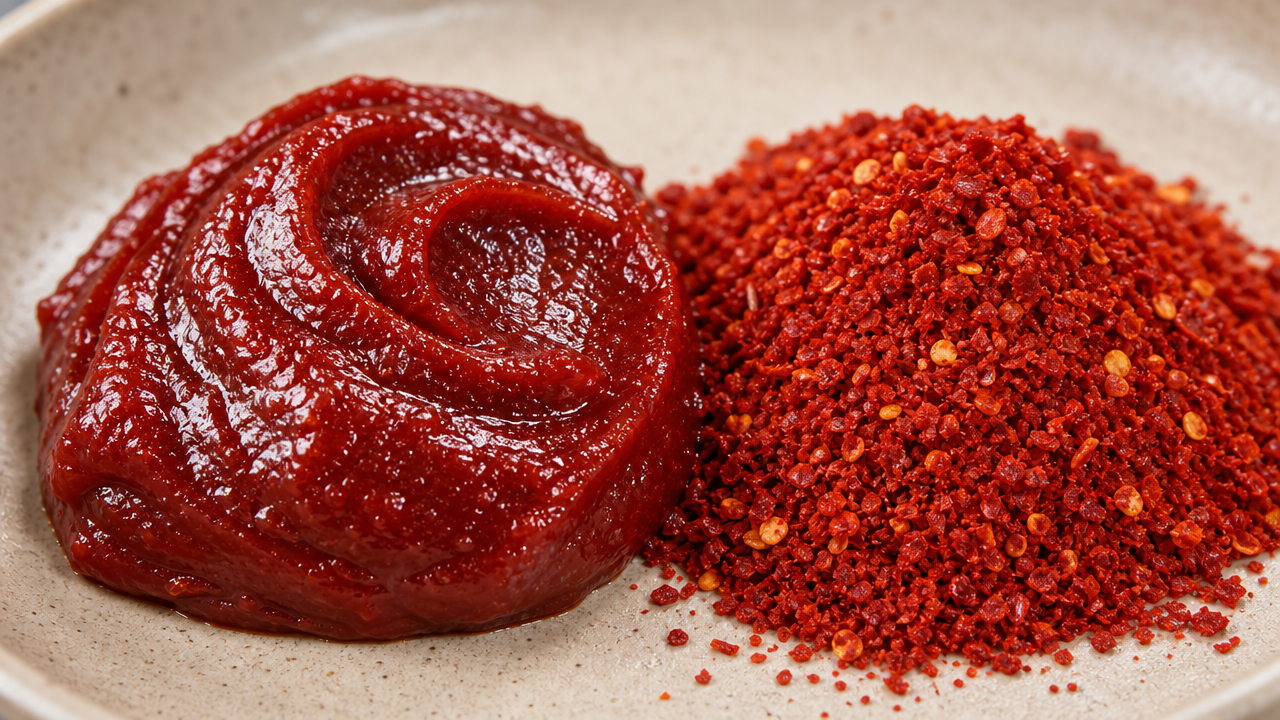
What is gochujang? If you’ve googled that exact question, you’re in the right place — here’s everything I wish someone had told me years ago.
A few months ago, a neighbor watched me spoon something dark red into a pot of soup and asked the question I hear more than any other: “Okay, seriously — what IS that stuff? Everyone online calls it gochujang, but nobody ever explains it.”
Fair point. Most articles about gochujang assume you already know what it is and jump straight to substitutes or brand rankings. But if you’re standing in an aisle somewhere in the US or UK holding a red tub, here’s the beginner’s guide I wish I could hand you.
Quick Answer: What Is Gochujang?
Gochujang (고추장) is Korea’s fermented chili paste — ground red chilies, glutinous rice, fermented soybean powder, and salt, aged for months until it becomes thick, dark red, and deeply savory. It’s the closest thing Korean cooking has to a secret ingredient: a little spoonful adds sweet, spicy, salty, and umami all at once.
If you’ve ever had bibimbap, tteokbokki, or Korean fried chicken, you’ve tasted it — it’s the red in all three.
What Does Gochujang Taste Like?
Honestly describing gochujang is harder than it sounds, because it’s not one flavor — it’s a chord. Here’s what actually happens when I taste it straight off the spoon:
- First: sweetness. The glutinous rice gives it a gentle, round sweetness that surprises people — it’s not a “hot sauce” in the Western sense.
- Then: warmth. The chili heat builds slowly. It doesn’t slap you like sriracha; it creeps up and lingers pleasantly.
- Finally: deep, savory umami. That’s the fermented soybean talking — the same kind of depth you get from miso or soy sauce, but sharper and bolder.
It’s also thicker than you probably expect — about the consistency of peanut butter or tomato paste, not a pourable sauce. That texture is part of why it coats food so well.
How Gochujang Is Made
This is the part that explains everything else. Traditionally, gochujang is made from four things:
- Gochugaru — Korean red pepper flakes, ground fine.
- Chapssal (glutinous rice) powder — this becomes the sweetness and the sticky body.
- Fermented soybean powder (meju) — this is the umami and the “fermented” character.
- Salt and water — for preserving and aging.
The mixture is packed into big earthenware pots (hangari) and left to ferment and age — in the traditional way, through a full season or longer. During that time, the ingredients literally transform into something new. That’s why store-bought gochujang still has “fermented” printed proudly on the label: the fermentation is the whole point.
The Part That Confuses Everyone: Gochujang vs Gochugaru vs Ssamjang vs Gochujang Sauce
This is where I lose people in real life, so let me settle it once and for all. These four are not the same thing, and buying the wrong one is the #1 beginner mistake:
| Product | What it is | What you do with it |
|---|---|---|
| Gochugaru | Red pepper flakes (crushed, not a paste) | Kimchi, soups, seasoning — added dry, like chili flakes |
| Gochujang | Fermented chili paste (thick, like peanut butter) | The cooking base — bibimbap, tteokbokki, stews, marinades |
| Ssamjang | Gochujang + doenjang + garlic + onion, ready-made dipping paste | Dipping sauce for lettuce wraps and BBQ — eaten as-is |
| Gochujang sauce (양념장) | Gochujang already thinned and seasoned for one job (usually bibimbap) | Poured straight over rice — but not a substitute for gochujang in cooking |
CJ Haechandle gochujang · 500 g tub (Amazon) → · Sempio vegan gochujang · 500 g tub (iHerb 5% off) → · CJ Haechandle gochujang · 500 g tub (Walmart) → · Sempio gochujang · 500 g tub (Instacart) →
Tae-kyung kimchi gochugaru flakes · 1 lb (Amazon) → · Mother-in-Law’s gochugaru · 3.25 oz (Instacart) → · CJ Haechandle ssamjang · 500 g green tub (Amazon) → · Bibigo gochujang sauce · 12.16 oz squeeze (Target) →
If a recipe says “gochujang,” you want the paste — the thick, dark red one. If you grab a bottle labeled “gochujang sauce” or “bibimbap sauce,” your tteokbokki will end up watery. My guide on reading Korean food labels shows you exactly where to look on the jar so this never happens again.
How to Store Gochujang
Good news: gochujang is a forgiving pantry resident. Once opened, keep it in the fridge. It keeps for many months — some jars last me well over a year — because the salt and fermentation preserve it. Two small things to know:
- The surface may darken or dry out over time — that’s oxidation, not spoilage. Just stir it.
- Keep the lid tight so it doesn’t dry into a brick. If it gets stiff, a few drops of water and a stir bring it back.
How I Actually Use Gochujang in a Normal Week
To make this concrete, here’s my real rotation:
- Bibimbap sauce — gochujang + sesame oil + honey + vinegar, whisked for 30 seconds. My full bibimbap sauce recipe has the exact ratio.
- Tteokbokki — gochujang IS the sauce. See my tteokbokki recipe for the version that works abroad.
- Marinades — a spoonful in bulgogi or chicken marinade adds depth no other ingredient can fake.
- Stews and jjigae — a small spoon dissolves into the broth and rounds it out.
- Ssam — mixed with a little sesame oil for lettuce wraps with grilled meat.
If you’re new to it, start with half a spoonful and build up. A little goes further than you think.
Is Gochujang Spicy?
Honest answer: mild-to-medium for most brands, and sweeter than people expect. It’s not a “challenge” hot sauce. The heat is warm and slow rather than sharp — which is exactly why it’s such a good entry point for people who usually avoid spicy food. You can also buy a mild version if your store carries one.
What Is Gochujang? FAQs
Is gochujang vegan?
Traditionally yes — the base is chili, rice, soybean and salt. But some brands add honey or even a touch of fish sauce, so if vegan matters to you, check the ingredient list.
Is gochujang gluten-free?
Also traditionally yes (it’s rice-based), but some commercial brands add wheat flour. The label will say. My label-reading guide shows you how to spot it fast.
Is gochujang the same as miso or doenjang?
No — same fermented-soybean family, but gochujang is the spicy, sweet one. The difference matters in cooking, and I wrote the full breakdown in Is Doenjang the Same as Miso?
Do I have to cook gochujang?
No — it’s already fermented and safe to eat as-is. Koreans eat it raw in ssam all the time. Cooking it just blends it into the dish.
Where to Buy Gochujang
You can find it at any Korean or Asian grocery store (H Mart in the US), and online at Amazon and Weee!. If you want to be sure you’re buying the real paste and not a sauce, my where-to-buy guide has the exact products with label photos.
Before you buy, it is worth seeing the same order priced at each store: which store actually wins on delivered price.
Related Guides
- Gochujang Substitute: 5 Tested Swaps — when you can’t find it
- 19 Korean Ingredient Substitutes That Actually Work
- Outside the US? Order Korean gochujang and pantry staples internationally on iHerb (5–10% OFF auto-applied) →.
My Final Word
If you take one thing from this guide: gochujang is not “Korean sriracha.” It’s a fermented paste with a flavor chord — sweet, warm, deep — that you can’t quite get from anything else. Buy the real paste, keep it in the fridge, and let it become the workhorse it is in Korean kitchens. Within a month it’ll be the jar you reach for without thinking.
Now that you know what is gochujang, try my bibimbap sauce recipe to taste it in action.
Shop These Gochujang & Pantry Staples by Store
Amazon (Prime delivery & 90-day cart guarantee)
CJ Haechandle gochujang · 500 g tub → · Tae-kyung kimchi gochugaru coarse flakes · 1 lb → · CJ Haechandle ssamjang seasoned dipping paste · 500 g → · Bibigo gochujang sauce · 12 oz squeeze →
iHerb (Direct global delivery & 5% rewards discount with code PNF305)
Sempio vegan gochujang · 500 g tub (5% OFF with code PNF305) →
Walmart (Curbside pickup & 2-day delivery)
CJ Haechandle gochujang · 500 g tub → · O’Food brown rice gochujang medium hot · 500 g tub →
Target (Order Pickup, Drive Up & same-day delivery)
Bibigo Korean-style hot & sweet gochujang sauce · 12.16 oz →
Instacart (Same-day local Korean & Asian market delivery)
Sempio gochujang chili paste · 500 g tub → · Mother-in-Law’s kimchi gochugaru flakes · 3.25 oz → · Sempio seasoned ssamjang · 1.1 lb → · Bibigo hot & sweet gochujang sauce · 12.16 oz →
