

TESTED IN MY KITCHEN • JINA MOON
By Jina Moon • Tested in my kitchen • 6 min read
Me at 9 pm: too tired to cook. Also me: willing to make one small effort for a bowl that tastes like I tried.
Doenjang ramen is one pack of instant noodles, 1 tbsp of doenjang and 2 cups (480 ml) of water — 15 minutes. The number that decides whether it tastes like dinner or like salt is the sodium: a full ramen packet plus a tablespoon of doenjang lands near 2,470 mg, while half a packet in the same bowl lands at about 1,660 mg.
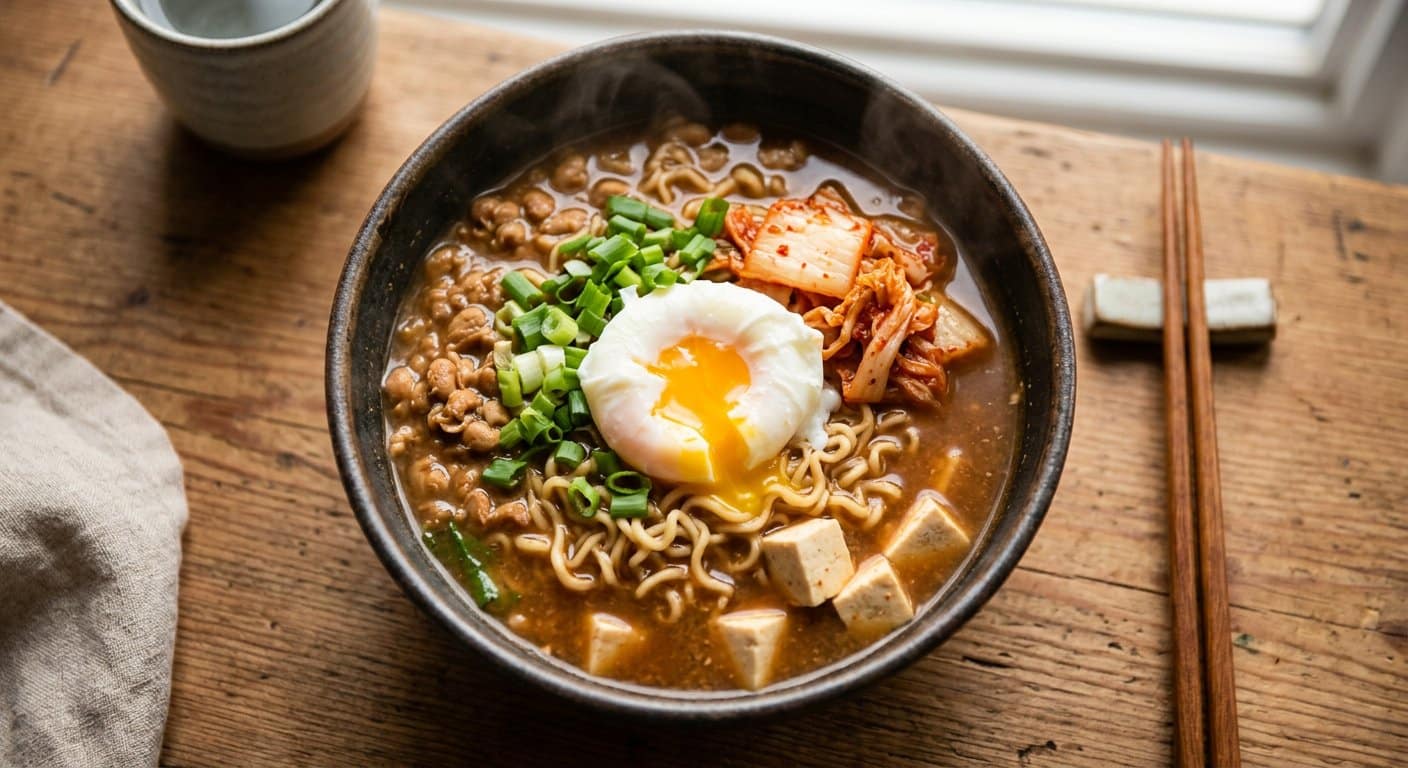
What it is: Doenjang ramen is a 15-minute Korean home-style noodle soup — instant ramen cooked in a savory broth of doenjang (Korean fermented soybean paste), scallions, and kimchi. It’s the “I’m tired, but I want something that tastes like effort” dinner.
You need: 1 pack of instant ramen, 1 tbsp doenjang, scallions — plus optional kimchi, tofu, and an egg.
No doenjang? Use 1 tbsp red miso + ½ tsp soy sauce — the exact swap from my Doenjang Substitute guide.
It’s 9 pm on a rainy Thursday in Washington. The fridge has a half-finished block of doenjang, a pack of instant ramen, some scallions, and one egg. In most kitchens that’s a “takeout night.” In mine, that’s dinner.
Doenjang ramen is one of those Korean home dishes you’ll almost never see on a restaurant menu — not because it’s complicated, but because it’s too easy. It’s the dish I’ve made more times than any other since moving away from Seoul: one pot, fifteen minutes, and a broth that somehow tastes like it’s been simmering for hours. It hasn’t.
Why Doenjang Makes Ramen Taste “Finished”
Instant ramen alone is that friend who only tells one joke. Salty, but flat. Doenjang fixes that by doing three jobs at once (the full breakdown is in my doenjang guide):
- Deep savory funk from a year+ of fermentation — the umami layer store-bought broth powders can’t fake.
- Salt structure — it seasons the whole pot, so the flavor has a backbone instead of just sweetness.
- Texture — the soft crushed soybean bits floating in the broth are half the experience.
Add the ramen’s own seasoning packet on top of that and you get a broth that’s savory, a little sweet, and faintly spicy. That’s the target.
Shopping List — Buy This First
Your tiny shopping list for maximum main-character dinner energy. Everything below is on Amazon in the US (and the UK). Total for a first bowl: about $9–$12, and the doenjang lasts a year, so it’s less after that.
| Item | What to buy | Link / swap |
|---|---|---|
| Doenjang (1 tbsp per bowl) | Sempio Doenjang (460g) or CJ Haechandle (500g) — around $7, keeps over a year in the fridge | Sempio on Amazon CJ Haechandle Doenjang (1.1 lb) Eden Organic Soybean Paste (5–10% OFF) · No doenjang? the 30-second miso swap → |
| Instant ramen | Any — Korean brands (Samyang, Ottogi) if you can find them. The seasoning packet is an asset here, not a cheat. | — |
| Scallions (green onions) | 2, cut into 1-cm pieces. Save the dark greens for the finish. | — |
| Kimchi (optional) | 2–3 slices, cut into strips. This is where the acidity comes from — I don’t skip it when I have it. | My ranked store-bought picks → |
| Egg (optional) | 1, cracked in and poached soft on top. | — |
| Tofu (optional) | Half a block, cubed. Soft tofu is perfect for this. | — |
| Sesame oil | A few drops at the end. If you already cook Korean food, you have it. If not, skip it without guilt. | — |
Quick Stock-Up: Grab all four shelf-stable essentials for this 15-minute bowl (Sempio Doenjang + Nongshim Spicy Ramen Pack + Jongga Sliced Kimchi + Ottogi Roasted Sesame Oil) individually or in a single click:
Sempio Doenjang Nongshim Spicy Ramen Pack Jongga Sliced Kimchi Ottogi Roasted Sesame Oil La Tourangelle Sesame Oil (5–10% OFF) Kadoya 100% Pure Sesame Oil
🛒 Add All 4 Doenjang Ramen Essentials in 1 Click CJ Haechandle Doenjang (1.1 lb) Eden Organic Soybean Paste (5–10% OFF)
More recipes built around what you can actually buy outside Korea: Korean recipes for cooks abroad.
No Doenjang? The 30-Second Swap
Empty tub, hungry human. Don’t wait for shipping — make the swap I use whenever the jar runs out:
1 tbsp Japanese red (or awase) miso + ½ tsp soy sauce + a tiny pinch of gochugaru, whisked into the broth in step 2.
It gets you about 90% of the way. The full reasoning, all five swaps I tested, and what to avoid (looking at you, hoisin) is in the Doenjang Substitute guide →
How to Make Doenjang Ramen
One pot. Fifteen minutes. Feeds one (two if you add a second pack and don’t tell me).
- Boil the water. Bring 2 cups (480 ml) of water to a boil in a small pot.
- Dissolve the doenjang. Turn the heat to medium, add 1 tbsp doenjang (or the miso swap) and whisk until it’s fully dissolved. Doing this before the noodles is the whole trick — no paste clumps at the bottom of your bowl.
- Add the seasoning. Toss in the ramen’s seasoning packet (or half of it, if it’s a strong one). It adds the sweet-spicy layer that doenjang alone doesn’t have.
- Simmer the aromatics. Add the white parts of the scallions, kimchi, and tofu. Simmer 2 minutes so the kimchi gives the broth its sour edge.
- Cook the noodles. Add the ramen block, breaking it gently. Cook 3–4 minutes, per the package.
- Crack in the egg. Poach it right in the broth for about 2 minutes — soft yolk, not a scramble (though scrambled is a style too).
- Finish. Dark scallion greens, a few drops of sesame oil, and — if you like heat — a pinch of gochugaru stirred in at the end.
- Taste before you eat. Too mild? A few more drops of soy sauce. Too sweet? A little more kimchi broth. Doenjang ramen is the one Korean dish I’m not precious about seasoning to taste.
The Ratio Table: Soup, Stew, or In Between
Soup era, stew era, or somewhere in between? The steps above are the baseline. The dial most people never touch is water — the same packet and the same spoon of doenjang turn into three different bowls depending on how much goes in.
| Style | Water per pack | Doenjang + packet |
|---|---|---|
| Light soup — drinkable, delicate | 600 ml (2½ cups) | 1 tbsp + 1/3 packet |
| House standard — soupy, with body | 480 ml (2 cups) | 1 tbsp + 1/2 packet |
| Stew-style — coats the noodles | 400 ml (1¾ cups) | 1½ tbsp + 1/3 packet |
Korean home recipes sit inside this same range — one widely copied version uses 600 ml of water with 1½ tbsp doenjang and a third of the packet, another uses 3 cups with ½ tbsp and half the packet. The ratio is a dial, not a law.
The Salt Math Nobody Does
Plot twist: the noodles are not the salty half. In a standard instant ramen pack, most of the sodium sits in the seasoning sachet, and the noodles carry the rest.
Two labels make it concrete. A US pack of Shin Ramyun lists 1,620 mg of sodium for the whole bag. One tablespoon (18 g) of Sempio doenjang lists 850 mg. Use both in full and the bowl is 2,470 mg — more than the 2,300 mg most adults are told to stay under for an entire day.
Half the packet (about 810 mg) plus the same spoon of doenjang (850 mg) comes to about 1,660 mg. That is still a salty bowl of noodles, but it is a bowl you can eat on a normal Tuesday. The broth does not taste thin, because the doenjang is doing the work the packet used to do — which is exactly why step 3 tells you to cut the packet before you reach for more paste.
- Never do both at full strength. Full packet plus a full tablespoon is the saltiest version of this dish and the least interesting one.
- Taste after the doenjang dissolves. If the broth is already savory, the packet is seasoning, not the base.
- Old tub, lighter hand. Doenjang gets saltier and more assertive as it sits; a jar from the back of the fridge can hit twice as hard as a fresh one.
One reading tip: sodium is printed per serving, and plenty of ramen packs pretend to be two servings. Look at the “per bag” column, not the headline number — the same habit I use in how to read Korean food labels. If you are still choosing the tub itself, the five doenjang tubs ranked here are compared by fermentation depth and price per gram.
Make It Yours
The base is done. Now it’s your bowl, your rules.
- Spicy version: swap the seasoning packet for 1 tsp gochugaru + 1 tsp soy sauce, and add a spoon of gochujang at the end.
- Leftover meat: cooked pork, bulgogi, or even Spam — whatever the fridge is holding. Stir it in at step 4.
- Vegetable-loaded: mushrooms, spinach, or any leftover veg, in at step 4. It’s a soup — it wants company.
- Double noodles, single broth: the only rule is that the broth ratio (1 tbsp doenjang per 2 cups water) doesn’t change. Add water, add doenjang, keep the ratio.
Want to see doenjang ramyun in motion? Aaron and Claire make it in this video, plus three more doenjang ideas for when one bowl is not enough.
Frequently Asked Questions
Is doenjang ramen a “real” Korean dish?
It’s home-style, not restaurant-style — the kind of thing made in Korean households, dorms, and office kitchens, especially by people too tired to cook properly. You won’t find it on a jjimjilbang menu. You will find it in a million homes.
How much doenjang do I use per bowl?
1 tablespoon per 2 cups of water is my baseline. It’s a range, not a law — taste at step 8 and adjust. Doenjang keeps getting stronger as it ages in your fridge, so an old jar might want a slightly lighter hand.
Should I really use the instant ramen seasoning packet?
Yes. I know it feels like cheating in a “real Korean dish.” It isn’t — it’s the sweet-salty layer that rounds out the doenjang’s earthiness. Half the packet if it’s a very strong flavor.
Does it keep?
One day in the fridge, but noodles get mushy, so I eat it the night I make it. If you make a double batch, cook the noodles separately and mix them in when you reheat.
Can I use ssamjang instead of doenjang?
Not straight — ssamjang is doenjang mixed with gochujang, sesame oil and sugar, and in a broth it turns sweet and thick instead of savory. If it is the only paste in the fridge: 1 tbsp ssamjang plus 1 tsp soy sauce, and skip the seasoning packet entirely. It makes a good bowl. It does not make doenjang ramen.
Why does my doenjang ramen taste flat?
Three usual causes, in order: too little doenjang for the amount of water (check the ratio table above), no acid in the pot (kimchi or a small splash of vinegar at the end fixes it), and a tub that has been open so long it has gone sharp and salty rather than deep. If it tastes salty but empty, the answer is scallion, kimchi or an egg — not another spoon of paste.
Bottom Line
Tell me you’re tired but still have standards without telling me.
- The dish: instant ramen in a doenjang broth with scallions, kimchi, and a soft egg — 15 minutes, one pot.
- The ratio that matters: 1 tbsp doenjang (or the miso swap) per 2 cups of water.
- The investment: one $7 jar of doenjang that turns every boring noodle night into a proper Korean one — for the next year.
Next Reads:
- Doenjang Substitute: 5 Alternatives I Tested (Miso, Ssamjang & More) — the full swap guide
- Best Store-Bought Kimchi on Amazon, Ranked (2026 Taste Test)
- Where to Buy Korean Ingredients Online (with label photos)
- Korean Food Glossary: 45 Essential Terms Explained
Shop These Doenjang Ramen Ingredients by Store
1. AMAZON US Prime members may see free two-day delivery on eligible items and addresses; check the item and checkout.
Sempio doenjang vegan original · 460 g tub Nongshim Shin Ramyun · 20 pouches Jongga sliced napa kimchi Ottogi 100% pure roasted sesame oil · 320 ml
2. iHERB Eligible orders may receive 5% off with code PNF305; check the actual discount at checkout. Shipping and exclusions vary.
La Tourangelle toasted sesame oil · 500 ml
3. WALMART US Pickup, delivery and shipping vary by item and ZIP code; order minimums and fees may apply.
Nongshim Shin Ramyun · 20 pouches
4. INSTACART Same-day grocery delivery or pickup may be available from participating stores in covered areas; fees and available slots vary.
CJ Haechandle doenjang · 1.1 lb tub Jongga napa cabbage kimchi · 10.6 oz Kadoya 100% pure sesame oil · 5.5 oz
Disclosure: This post contains affiliate links. If you buy through my links I may earn a small commission at no extra cost to you. As an Amazon Associate I earn from qualifying purchases.
