
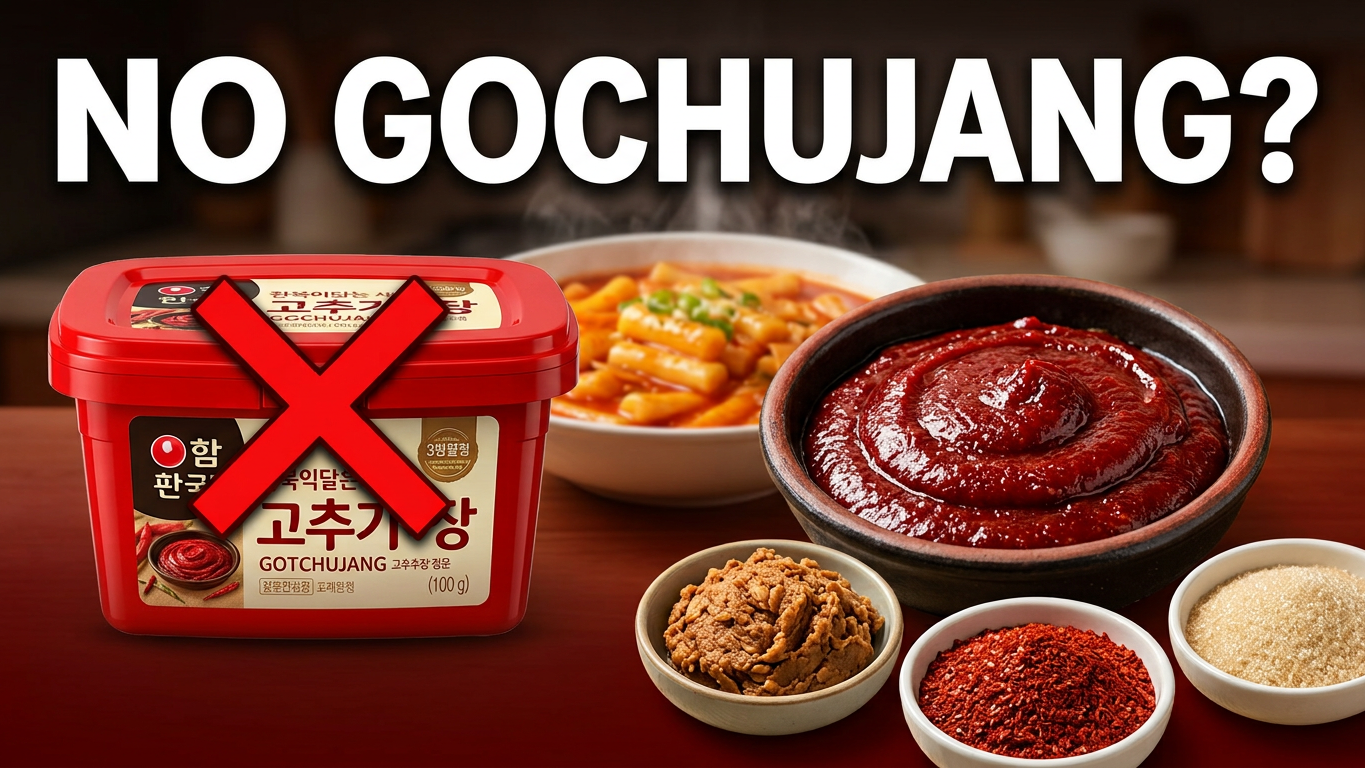
K Food Explained tested seven gochujang substitutes in October 2026. The closest 1:1 swap was fermented soybean paste plus gochugaru, sugar and water — the ratio table below converts it for any recipe amount.
I’m Jina Moon, a Seoul-born home cook living 40 minutes from the nearest Korean market — which means I run out of gochujang more often than I’d like to admit. For this guide I made the same gochujang marinade and the same tteokbokki with 7 different swaps, scored each for taste and texture, and kept only the ones my husband couldn’t tell apart from the real thing.
QUICK ANSWER
The best gochujang substitute is 1 tsp doenjang + 1 tsp gochugaru + 1/2 tsp sugar — the only swap I tested that keeps the sweet heat, the umami, and the sticky thickness.
Avoid: plain chili paste or sriracha-only mixes — they taste sharp and thin, not deep and sticky like gochujang.
KEY TAKEAWAYS
- Best swap: doenjang + gochugaru + sugar (works in marinades, bibimbap, even tteokbokki in a pinch)
- Best for stews: doubanjiang + sugar
- Never use: sambal oelek or sriracha alone in cooked dishes
- Real thing: $6–8 on Amazon, lasts 6 months — usually worth the wait
What gochujang actually does (so you know what to replace)
Gochujang isn’t just “spicy.” In a recipe it does three jobs at once:
- Sweet: from glutinous rice and fermentation — not just added sugar
- Heat: from gochugaru (Korean chili flakes) — smoky and round, not sharp
- Body: a thick, sticky paste that coats rice, tteok, and meat
A substitute that only brings heat (sriracha) or only salt (miso) will taste “off” even when you can’t say why. The swaps below are ranked by how many of those three jobs they cover. New to the ingredient? Read What Is Gochujang? A Beginner’s Guide first.
Quick pick by dish
- Tteokbokki / gochujang jjigae (gochujang is the star): don’t substitute if you can help it — buy the real thing. Emergency: Swap #1.
- Marinades (bulgogi-style, LA galbi): Swap #1 (doenjang + gochugaru + sugar).
- Bibimbap: Swap #1 or #3 (ssamjang). Try my 5-minute bibimbap sauce recipe.
- Dipping sauce / drizzle: Swap #6 (sriracha + miso) is fine.
Gochujang Substitute Calculator
Type the amount of gochujang your recipe calls for and pick what you actually have. You get exact component amounts, not just “use some miso.” The ratios are the ones from the table below, tested at 1 tbsp and scaled up.
Quick reference for 1 tbsp gochujang: 1 tsp doenjang + 1 tsp gochugaru + ½ tsp sugar + ½ tsp water. If the controls do not appear, use this line and double it for each extra tablespoon.
Good to know: these are volume ratios. They rebuild gochujang’s three jobs — sweet, heat and body — but they do not recreate the fermented depth exactly. Taste before adding more salt. Ssamjang and sriracha are much saltier or sharper than gochujang, so reduce salt elsewhere.
The 7 gochujang substitutes, ranked (ratios per 1 tbsp gochujang)
I tested each swap twice: once in a gochujang marinade (LA galbi) and once in cooked tteokbokki sauce. Scores are out of 5.
#1 · BEST SWAP
Doenjang + gochugaru + sugar — taste 4.5/5 · texture 4/5
Ratio: 1 tsp doenjang + 1 tsp gochugaru + 1/2 tsp sugar (+ 1/2 tsp water to loosen).
Rebuilds all three pillars: fermented soy umami, Korean chili heat, real sweetness. In the marinade test it was nearly indistinguishable after cooking. My go-to when the tub is empty. Grab doenjang on Amazon and gochugaru on Amazon. (Also out of doenjang? See my doenjang substitute guide.)
#2 · BEST FOR GLAZES
Red miso + gochugaru + honey — taste 3.5/5 · texture 3.5/5
Ratio: 1 tsp red (aka) miso + 1 tsp gochugaru + 1/2 tsp honey.
Smoother and less funky than doenjang, so the result is slightly “cleaner” than real gochujang — great in marinades and glazes like gochujang butter. White miso only in a pinch; it’s too sweet and thin.
#3 · LAZY SWAP
Ssamjang 1:1 — taste 3/5 · texture 3.5/5
Ssamjang already contains gochujang plus doenjang and sesame, so it’s saltier and nuttier. Fine for bibimbap and dipping; too salty for tteokbokki unless you halve the salt elsewhere.
#4 · BEST FOR STEWS
Doubanjiang + sugar — taste 4/5 (cooked) · texture 4/5
Ratio: 1 tsp doubanjiang + 1/2 tsp sugar; ease off other salt.
The closest single-ingredient swap in a jjigae or braise — thick, fermented, spicy. Wrong choice for cold dishes; the raw bean flavor needs cooking. Doubanjiang on Amazon is easy to find.
#5 · DIPPING ONLY
Thai sweet chili sauce + gochugaru — taste 3/5 · texture 2.5/5
2 tsp sweet chili sauce + 1/2 tsp gochugaru. Too sweet and too thin for stews, but acceptable as a dipping sauce or fried-chicken drizzle.
#6 · LAST-RESORT DIP
Sriracha + miso — taste 2/5 · texture 2/5
2 tsp sriracha + 1 tsp miso + a pinch of sugar. My husband’s verdict: “tastes like hot ketchup.” The vinegar in sriracha reads loudly in cooked dishes — never in jjigae. Full breakdown in Gochujang vs Sriracha: Can You Swap Them?
#7 · AVOID
Plain chili paste / sambal oelek — taste 1.5/5
Just heat, no sweetness, no body. It turned my tteokbokki into spicy water with rice cakes in it. Only use it to add heat to a sauce that already gets sweetness and umami elsewhere.
HOW TO MAKE SWAP #1 PROPERLY (MY RECIPE)
For 1 tbsp gochujang: mix 1 tsp doenjang (Japanese miso in a pinch) + 1 tsp fine gochugaru + 1/2 tsp sugar + 1/2 tsp water into a paste. Add a drop of sesame oil if you have it. Use 1:1 — and let it sit 5 minutes so the flakes hydrate and the raw chili edge softens.
Which gochujang substitute for which dish
- Tteokbokki: real gochujang if at all possible (try my tteokbokki recipe); emergency Swap #1 with an extra 1/2 tsp sugar.
- Bibimbap: Swap #1 or ssamjang.
- Jjigae / braises: Swap #4 (doubanjiang + sugar).
- Marinades & gochujang butter: Swap #2 (red miso blend).
- Cold dipping sauce: Swap #6 or #5.
What never works as a gochujang substitute
- Ketchup + chili flakes: too sweet, too acidic — reads as cocktail sauce.
- Tabasco / vinegar-based hot sauce: too thin, too sour; breaks the sauce texture.
- Sriracha alone: heat with no body and no fermented depth.
Where to buy real gochujang (US / UK / EU)
MY REPEAT BUY: CJ HAECANDLE OR SEMPIO (500g)
Not too sweet, not too hot — the versions most Korean households actually use. Amazon · CJ Haechandle · 500 g tub → Amazon · Sempio mild · 500 g tub → iHerb · Sempio · 500 g tub → Instacart · Sempio vegan · 17.63 oz tub →. UK: Amazon.co.uk · EU: Amazon.de — search the same names.
On the label look for the word “gochujang” plus a chili icon; avoid tubs that say “ssamjang” in big letters. I compared 6 brands in 6 Best Gochujang Brands on Amazon, and label photos live in my Where to Buy Korean Ingredients Online guide.
Skip the Substitute — 1-Click iHerb Gochujang Cart: Want real Korean gochujang and soy sauce delivered with low free-shipping thresholds in the US, UK, EU, or Canada? See Sempio Gochujang (500 g) on iHerb →
Buying anything chilled or frozen? Check which stores will ship chilled items to you before you fill a cart.
Gochujang substitute FAQ
Is ssamjang the same as gochujang?
No. Ssamjang = gochujang + doenjang + sesame oil. Saltier and nuttier. Usable 1:1 in bibimbap, but reduce salt elsewhere.
Is there a non-spicy substitute (for kids)?
Mix 1 tsp doenjang + 1/2 tsp ketchup + a pinch of sugar. Not spicy, but keeps the sweet-savory base.
Is gochujang gluten-free or vegan?
Usually vegan, but many brands contain barley or wheat — my Korean food label guide shows where to look. Gluten-free versions exist; search “gluten free gochujang” on Amazon.
How long does an opened tub last?
About 6 months in the fridge. It darkens and deepens over time — that’s normal fermentation, not spoilage.
Bottom line
- Best swap: doenjang + gochugaru + sugar (Swap #1)
- Good enough: red miso blend for glazes, ssamjang for bibimbap, doubanjiang for stews
- Don’t: plain chili paste or sriracha mixes in cooked dishes
If you cook Korean food more than twice a month, just buy a tub — $7 fixes every substitute problem.
Next reads: 6 Best Gochujang Brands on Amazon · Gochujang vs Sriracha · Doenjang Substitute: 5 Tested Alternatives
Shop Real Gochujang and the Swap Ingredients by Store
Already picked your favorite? Here are the same products grouped by store. Amazon buttons add that one item to your Amazon cart, where you can review or remove it; the other stores open the exact product page. Stock, fees and delivery depend on your location.
Amazon — 5 items
1. AMAZON US Prime members may see free two-day delivery on eligible items and addresses; check the listing and checkout.
CJ Haechandle gochujang · 500 g tub → Sempio mild gochujang · 500 g tub → CJ Haechandle doenjang · 500 g tub → Nongshim Taekyung coarse · 1 lb bag → SXET Pixian doubanjiang · 500 g →
iHerb — 1 item
2. IHERB Eligible orders may receive 5% off with code PNF305; check the actual discount at checkout. Shipping and exclusions vary.
Sempio gochujang · 500 g tub →
Instacart — 1 item
3. INSTACART Same-day grocery delivery or pickup may be available in covered areas; retailer, time slots and fees vary.
Sempio vegan gochujang · 17.63 oz tub →
The doenjang, gochugaru and doubanjiang buttons are for the substitute mixes above; the gochujang tubs are the real thing.
Shopping from outside the US? Compare local availability and the final delivered price with our Korean grocery shopping guide.
