
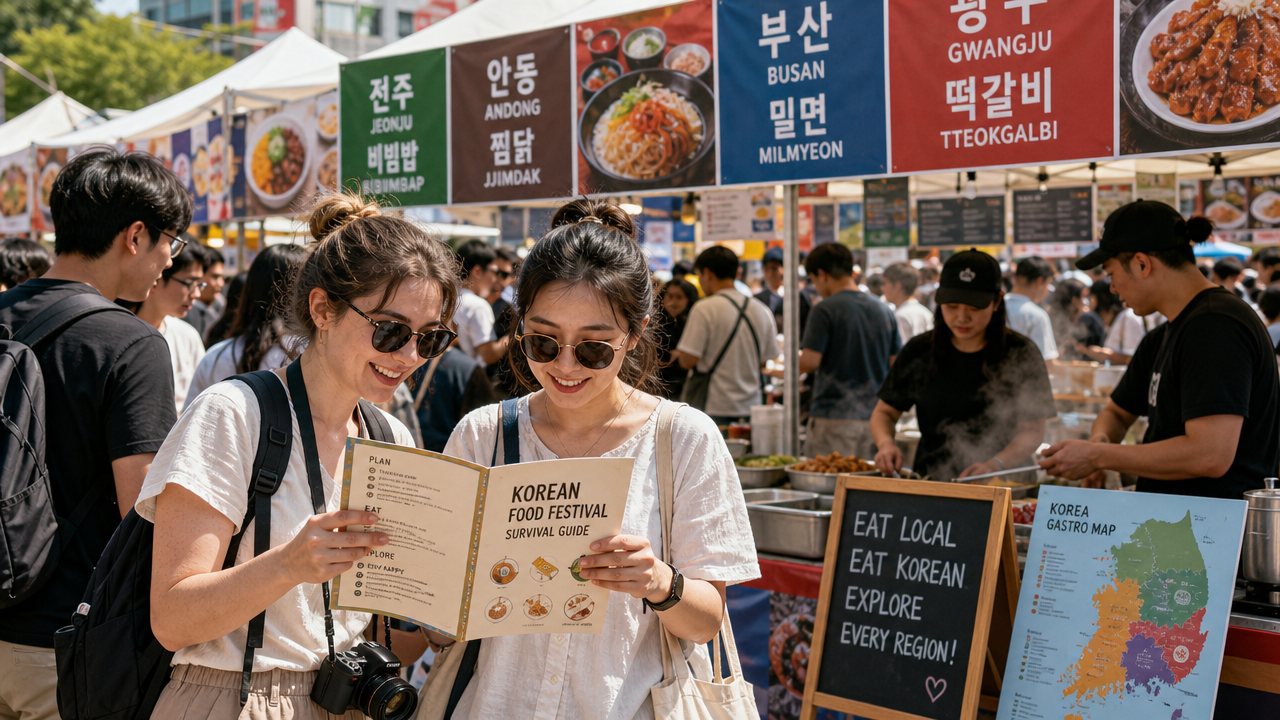
The first Korean food festival I remember clearly was not difficult because of the food. It was difficult because I arrived hungry, joined the longest line without checking what it sold, and bought enough at the first stall to make the rest of the festival impossible. I grew up in Korea, but a crowded regional event can still humble me.
This Korean food festival survival guide is the plan I wish I had followed. It is written especially for visitors coming from North America or Europe who may be navigating a rural bus stop, a Korean-only sign, a foreign credit card, and an allergy question at the same time.
For dates and destinations, use my Korean food festival calendar. If you are deciding between Sunchang, Gwangju, and Gimcheon in autumn 2026, my October 2026 festival comparison explains which one fits different travelers.
Quick answer: Confirm the event on its official page, save the venue name in Hangul, arrive early, carry a second payment method, share small portions, and never assume an unlabeled dish is safe for an allergy. The goal is not to eat everything. It is to leave with a clear memory of what made that region’s food different.
Korean Food Festival Survival Guide: The 17 Things That Matter
1. Verify the festival on an official page
Festival blogs and social posts are useful for inspiration, but they can keep last year’s dates, venue, or program after plans change. I check the organizer’s website or the Korea Tourism Organization listing first. Then I check again a few days before travel for weather notices, parking changes, shuttle details, and reservation links.
A date can be confirmed while the detailed program is still based on the previous year. When an official page says that the schedule is being updated, treat food demonstrations and hands-on activities as tentative until the final timetable appears.
2. Save the venue in Hangul, not only English
Romanized festival names can be written several ways. A driver or local bus search is more likely to recognize the Korean name. I save the festival name, the street address, and one nearby landmark in my phone. I also take a screenshot in case the connection becomes weak.
For navigation, I use Naver Map or KakaoMap. VISITKOREA recommends Korean map services because they provide local route and navigation information that international visitors may not get from their usual map app.
3. Check the last trip home before the first trip out
This matters most in a county or village. A festival may run into the evening while the last useful bus leaves earlier. Before I commit to a train or intercity bus, I work backward from the return connection. If the organizer announces a temporary shuttle, I save its boarding point and final departure time rather than assuming it runs continuously.
4. Choose one priority before you arrive
My priority is usually tasting a regional specialty or joining one making activity. Someone else may care more about a chef demonstration, children’s program, or concert. Pick one non-negotiable item and build the day around it. Otherwise, it is easy to spend the best hour comparing stalls and miss the only scheduled experience you wanted.
5. Reserve limited programs early
Kimchi making, jang workshops, brewery tastings, and chef sessions may use advance registration or timed tickets. An event can have free admission while charging separately for an activity. Translate the booking page before the day of the festival, and save the confirmation screen as well as the email.
6. Arrive before lunch crowds
My favorite festival hour is usually the first calm hour after the stalls are fully open. Vendors still have time to answer a short question, tables are easier to find, and popular items have not sold out. If opening time is 10:00, I would rather arrive around opening than walk in at 12:30 already hungry.
7. Do one orientation lap before buying a full meal
I break this rule more often than I should. A quick lap tells me which stalls are unique to the region, which lines move quickly, where the water and restrooms are, and whether the same dish appears at five prices. I photograph the stall name of anything I want to revisit.
What to Pack for a Korean Food Festival
- Comfortable closed shoes: festival days involve more standing than the map suggests.
- A light layer and compact rain protection: a warm afternoon can become a cool evening.
- A small reusable bag: useful for sealed products and brochures.
- A separate leakproof bag: essential if you buy jang, kimchi, oil, or another aromatic product.
- Water: especially when tasting salty, spicy, or alcoholic products.
- Tissues and hand wipes: outdoor tables run out at the worst moment.
- A charged phone and power bank: maps, translation, tickets, photos, and payment can all depend on it.
- Any prescribed allergy medication: carry it according to your medical plan; a festival first-aid tent is not a substitute.
- A small amount of Korean won plus two cards: most businesses accept cards, but a temporary stall or foreign-card authorization can still fail.
I keep the bag light. A full backpack becomes uncomfortable in a dense line and bumps into people every time I turn around.
How to Order Food Without Freezing Up
You do not need fluent Korean. Pointing politely, showing a quantity with your fingers, and using one short sentence is usually better than reading a long translation while a line waits behind you.
| Korean | Meaning | When I use it |
|---|---|---|
| 이거 하나 주세요. Igeo hana juseyo. | One of this, please. | The most useful stall sentence. |
| 얼마예요? Eolmayeyo? | How much is it? | When the price is not visible. |
| 카드 돼요? Kadeu dwaeyo? | Do you take cards? | Before the vendor prepares the order. |
| 시식해도 돼요? Sisikhaedo dwaeyo? | May I sample it? | Only when sampling is not clearly offered. |
| 안 매운 거 있어요? An maeun geo isseoyo? | Do you have something not spicy? | Remember that “not spicy” does not mean allergy-safe. |
| 포장해 주세요. Pojanghae juseyo. | Please pack it to go. | For food meant to leave the stall. |
| 화장실 어디예요? Hwajangsil eodiyeyo? | Where is the restroom? | Worth saving before you need it. |
A screenshot of the exact dish name is also useful. If I hear a word I want to remember, I type it into my notes immediately instead of trusting my memory after ten tastings.
Payment: Cards Are Common, but Carry a Backup
VISITKOREA notes that credit cards are widely accepted in Korea, including for small purchases. That does not mean every foreign card will work at every temporary booth. Some festival sellers may use a different terminal, cash, or a local mobile payment system that a visitor cannot set up.
- Carry Visa or Mastercard if possible, plus a second card kept separately.
- Tell the vendor you need to check card acceptance before the food is prepared.
- Keep a modest amount of cash for stalls, lockers, or transport gaps.
- Do not expect a transportation card to work as a universal festival payment card.
- Check the amount on the terminal before tapping or inserting your card.
I also photograph or keep the receipt when I buy a packaged product. It helps me remember the producer and gives me something to show if the wrong item went into the bag.
Food Allergies and Dietary Needs
A handwritten sign that says “vegetable” or “tofu” cannot tell you what is in the broth, sauce, kimchi seasoning, or shared fryer. Korean festival food may contain soy, wheat, sesame, egg, milk, peanuts, tree nuts, fish, shellfish, meat broth, fish sauce, or salted shrimp. Ingredients vary by vendor and cross-contact is common in small temporary kitchens.
For a serious allergy, I would carry a professionally translated card naming the exact ingredient and explaining that shared utensils or oil are unsafe. I would not rely only on a translation app or on the word “vegetarian.” If the vendor seems uncertain, I do not eat the dish.
Useful sentence: 알레르기가 있어서 [ingredient]을/를 먹을 수 없습니다. 같은 조리도구를 사용한 음식도 먹을 수 없습니다.
I have an allergy and cannot eat [ingredient]. I also cannot eat food made with the same cooking utensils.
Two common questions are 새우젓이나 액젓이 들어가요? (“Does it contain salted shrimp or fish sauce?”) and 고기나 고기 육수가 들어가요? (“Does it contain meat or meat broth?”). These questions do not guarantee safety; they simply make the hidden ingredients easier to discuss.
For packaged purchases, use my Korean food label guide to check the ingredient list, allergens, storage, and use-by date.
How to Taste More Without Wasting Food
- Share one portion. Two or three people can compare far more dishes than each person buying a full serving.
- Start mild. Strong chilli, smoke, garlic, or sweetness can flatten the next sample.
- Alternate food and water. This slows the day down and resets your palate.
- Write one line. I note “more fermented,” “less sweet,” or “good texture” rather than trying to write a restaurant review.
- Stop before you are full. Leave space for the one dish you did not know existed.
Free samples are invitations to taste, not lunch. I take one, listen if the producer is explaining it, and move aside before discussing it with my family.
Festival Etiquette That Makes the Day Easier
- Join the visible line rather than crowding the front to ask what is sold.
- Do not hold a table with bags for a long time when others are carrying hot food.
- Ask before taking a close photo of a vendor, child, or food-making demonstration.
- Return reusable tasting cups where instructed and sort rubbish according to the signs.
- Keep translation questions short when the stall is overwhelmed.
- Do not assume a sample is free unless it is clearly offered.
- If you drink alcohol, use public transportation and keep the tasting size small.
The most respectful thing is often simple: notice when a producer is busy. I save longer questions for a quiet moment or use the website printed on the package later.
Crowds, Children, and Meeting Points
A food festival can become surprisingly dense around lunch and stage performances. If I am with family, we choose a meeting point before entering—something fixed like an information tent, not “the tteokbokki stall.” I put the Korean address and one phone number in a child’s pocket.
Strollers can be useful but difficult on grass, gravel, and narrow food lanes. Check the venue map, bring hearing protection if a concert is part of the event, and plan a quiet break away from the main stage. Families enjoy more when every hour is not scheduled.
Buying Jars, Bottles, and Refrigerated Food
Festival shopping is tempting because the producer is standing in front of you and the packaging is beautiful. Before buying, I ask four questions: Does it need refrigeration? When should it be opened? Can it leak or build pressure? Is it allowed into my destination country?
- Jang and sauces: keep the seal intact and place the container in a separate leakproof bag.
- Kimchi and fresh food: ask about the cold chain and realistic travel time.
- Live makgeolli: it may continue fermenting, needs refrigeration, and can be a poor choice for a long flight.
- Alcohol: airline, security, customs, and destination-state rules all matter.
- Meat, fresh produce, and seeds: destination-country restrictions can be strict even when the item is commercially packaged.
Rules differ among the United States, Canada, the United Kingdom, and EU countries. I check my destination customs authority rather than trusting the vendor to know another country’s current rules.
Shopping from outside the US? how the same order ships outside the US is the part most guides skip.
A Simple First-Timer Schedule
| Time | Plan | Why |
|---|---|---|
| Opening time | Map, restroom, information desk, one orientation lap | You learn the layout before lines grow. |
| First hour | Priority tasting or reserved activity | Energy is high and popular items remain. |
| Before lunch peak | Share two or three small dishes | You avoid buying one huge meal in panic. |
| Early afternoon | Exhibition, market, or quieter demonstration | This gives your feet and palate a break. |
| Late afternoon | Return to the best stall and buy sealed products | You now know what deserves suitcase space. |
| Before leaving | Check return transport and photograph purchases | No sprint for the last bus and no mystery jars later. |
Seven Mistakes I Would Avoid Next Time
- Planning from an old blog post without checking the organizer.
- Arriving hungry at the busiest hour.
- Buying a full portion at the first attractive stall.
- Assuming every activity is included with free admission.
- Using “not spicy” as if it means child-safe or allergy-safe.
- Buying refrigerated food before several hours of walking.
- Waiting until the bus stop to check the last departure.
Frequently Asked Questions
Do Korean food festivals usually have English signs?
Major events may provide English maps or visitor information, but individual stalls and temporary signs can be Korean only. Save names in Hangul and keep a translation app ready.
Do I need cash at a Korean food festival?
Cards are widely accepted in Korea, but a foreign card can fail and some temporary stalls may use cash or local payment methods. Carry a small amount of won and a second card.
What time should I arrive?
Opening time or the first hour is usually best for easier navigation and shorter food lines. Confirm when food stalls actually begin serving rather than relying only on the stage schedule.
Can vegetarians eat at Korean food festivals?
Often yes, but vegetable dishes may contain meat broth, fish sauce, salted shrimp, or shared cooking oil. Ask about the complete dish and do not assume a visible vegetable filling makes it vegetarian.
Are Korean food festivals free?
Many have free general admission, but food, products, parking, and hands-on programs may cost extra. Check each official listing.
Who can help if I am lost or need interpretation?
The Korea Tourism Organization’s 1330 Travel Helpline offers travel information and interpretation by phone and real-time chat. Save it before the trip rather than searching during a problem.
